

How often do you find yourself thinking, “It won’t work anyway”? That’s exactly when your inner critic kicks in. Many of us are familiar with that voice that immediately puts the brakes on as soon as a new idea pops into our heads. I’ve experienced it myself on a regular basis – and I know how quickly it can slow you down.
Studies show that mindfulness and meditation can reduce rumination and help sharpen your focus. This often leads to new ideas popping up because you learn to turn down the noise in your head.
In two minutes, you’ll get a mini exercise that you can try out right away – no woo-woo spiritual stuff, just practical stuff. And you’ll notice that for many people, it feels like an instant reset that quickly brings clarity.
Let’s take a look at how you can create more space in your head with a few simple steps.
Table of contents
Why your mind prefers to run on autopilot – and what that has to do with creativity

Imagine your head is like a messy desk: old scraps of paper, notes and odds and ends are scattered everywhere. There’s no room for new ideas because everything is full. At times like these, it quickly feels like you’re running on autopilot – the same thoughts over and over again, the same processes over and over again. And that’s exactly what often blocks your creativity. So it’s usually not a question of talent, but of ingrained habits.
Your brain loves to save energy. Like an athlete who always runs the same route: safe, comfortable, no surprises. That’s why certain thoughts come to mind particularly easily – they have a “built-in shortcut”, so to speak. Blockages feel so persistent because your mind simply does what it knows. This is completely normal, even people who work creatively every day are familiar with this. They often report that the best ideas come when they are not thinking specifically about something – for example, when walking, showering or just before falling asleep. During these breaks, the mind can suddenly make new connections.
vegan Meditation cushion
-

Anahata Harmony
49,95 € -
Manipura Strength
49,95 € -
Muladhara Balance
49,95 € -
Sahasrara Connect
49,95 €




This is where the default mode network comes into play. This is a brain network that becomes active when you are resting and your mind is wandering, and is often associated with the emergence of new ideas. During periods of rest, the brain reorganises information, which can improve the conditions for new ideas. Studies show that when you are daydreaming or switching off, your brain is working in the background, linking old memories with new impressions. It is like internal brainstorming without pressure. The important thing to remember is that creativity does not come from thinking too hard, but from giving your mind space to wander.
So you don’t have to try to completely clear your mind – that rarely works anyway. Meditation and mindful observation are more about noticing your thoughts without immediately judging them. Imagine your thoughts are like clouds passing by. You simply observe what is there – without intervening directly. With a little practice, you will quickly recognise patterns: perhaps you notice that your inner critic always becomes particularly loud when an unusual idea arises. Or that you are immediately distracted as soon as the topic of work comes up.
Tip: Observe for 30 seconds what kind of thoughts keep coming up – this is your first diagnostic step. This will help you recognise typical thought loops and interrupt them in a targeted manner. It’s like a reset button for your mind. For advanced learners: Try not only to recognise these patterns, but also to consciously question them – where do they come from, and are they really helpful?
Blockages are therefore not a sign of weakness, but rather indicate that your brain is currently operating in energy-saving mode. The good news is that you can actively change this mode and thus create space for new ideas.
And this is precisely where the inner critic plays a crucial role.
The inner critic – saboteur or secret coach?
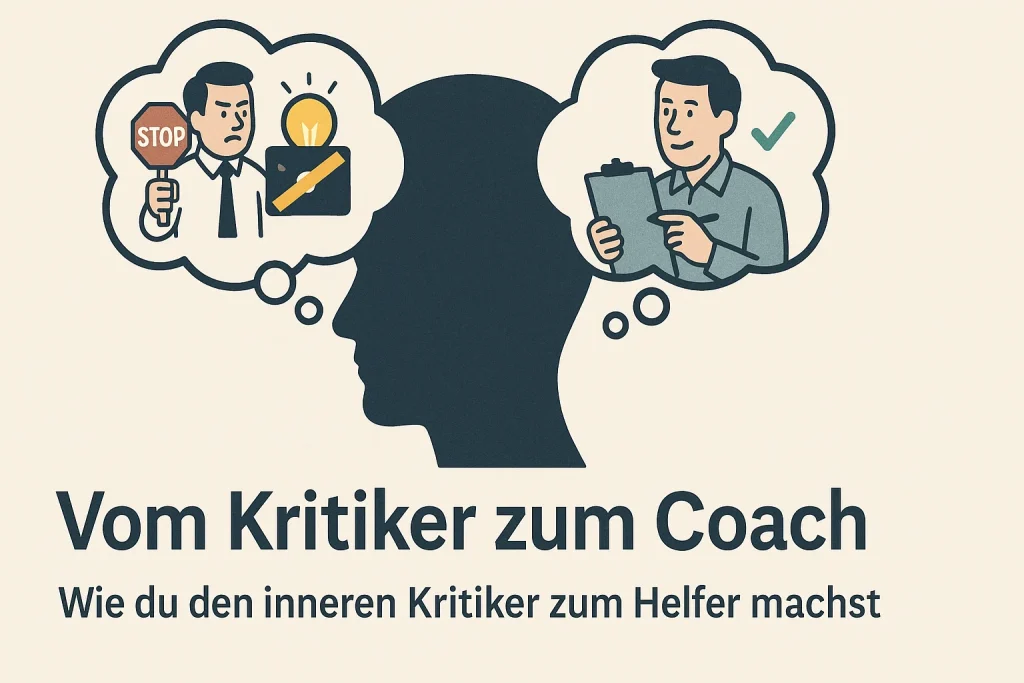
You probably know that inner voice that pipes up as soon as you try something new: “Forget it, you can’t do that.” Or it whispers: “Others do it much more easily – why should you even try?” That voice is your inner critic. It often pops up just when you venture into unknown territory or want to bravely test a new idea. Many people try to simply ignore it – as if you could just turn off an annoying alarm clock. But most of the time, this only makes it louder, especially when it comes to creativity or change.
The exciting thing is that the inner critic originally developed as a protective mechanism – like a safety belt for the psyche. It wants to protect you from mistakes, embarrassment or rejection. But what used to be helpful can quickly become a hindrance today. Research shows that brooding and self-criticism not only block creativity, they also put you in a bad mood and make you doubt yourself. What was intended as protection thus becomes an obstacle.
Crystals in meditation practice
Many people say that meditation with crystals is just esotericism—but recent studies on mindfulness …
Perhaps you have already noticed: the more you argue with your inner critic or try to push it away, the more it intensifies. Pushing it away makes it worse. Observing helps. It’s like in sports: when you fight against resistance, it gets stronger. If you leave it alone and observe it, it often loses its power. Creative people in particular are familiar with these endless loops – the constant brooding, the self-doubt that paralyses you before you even get started.
What can you do? Instead of suppressing the voice, try the following: give your critic a new job. This can be done in three steps – and takes less than a minute. First, give the voice a name, for example, ‘The Doubter’ or ‘The Perfectionist’. Second: briefly ask yourself what concern lies behind it. What does this voice actually want to prevent? Third: say to yourself, “Okay, you can check – but don’t stop everything right away.” Allow the critic to test ideas, but don’t block them immediately. It’s like brainstorming: collect everything first, you can evaluate it later. In research, this strategy is called “decentring” – you observe your thoughts without taking them at face value. Studies show that this way of thinking can be trained with mindfulness exercises and helps you to remain more creative and relaxed in the long term.
Many people notice changes after just a short time – their minds become clearer and new ideas can emerge. For some, repetition is needed before the pattern really shifts. This is normal and no reason to become impatient.
Important: If your inner critic is very loud, if stressful memories come to mind, or if the exercise makes you feel uneasy, then stop. Get support – sometimes you need a professional to guide you.
With a little practice, your inner critic will gradually become a coach who no longer holds you back, but instead reviews and sorts through your ideas. This creates an inner testing ground where even the most unusual ideas have a place. And who knows – maybe one of them will be the idea you’ve been searching for all along.
I’ll show you a simple exercise that will help you make room for new thoughts in your head even faster.
Breath as a brush: instant exercise for fresh ideas
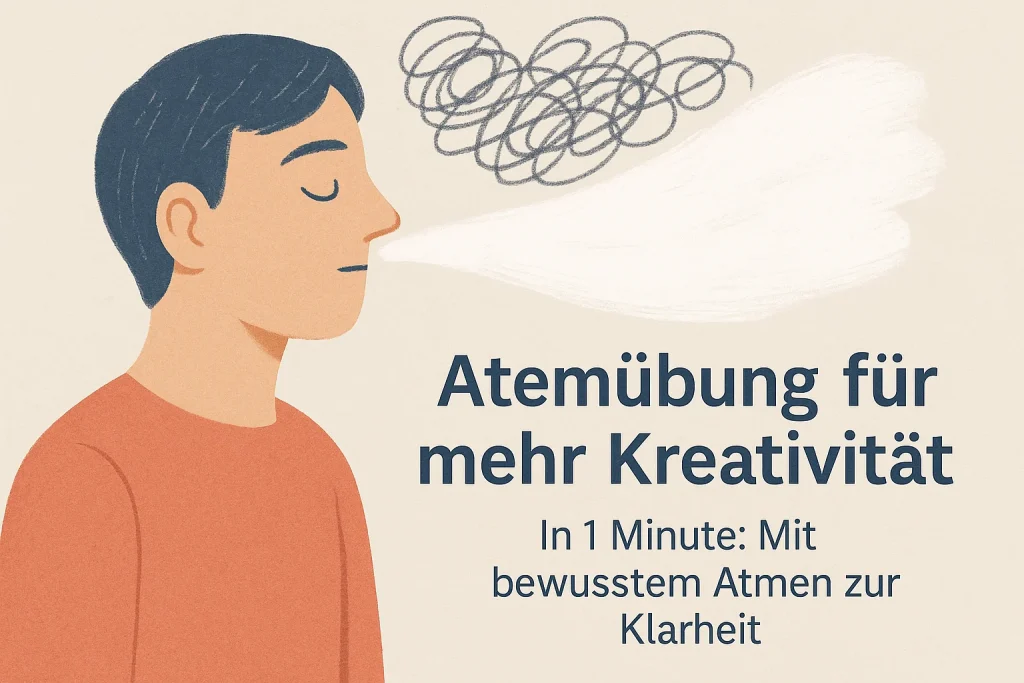
Many people still imagine meditation to be simply sitting around waiting for their mind to go blank. Sounds pretty boring at first, doesn’t it? But meditation is actually like a quick system check for your mind. You’re not pressing pause, but giving your mind the opportunity to reorganise itself – similar to a laptop that works better after a restart. Research shows that just a few minutes of conscious breathing or mindfulness exercises can help sharpen your attention and, over time, improve your emotional regulation. Many people experience greater clarity after a short period of conscious breathing – even if the effects are often small and increase with practice.
Imagine your breath as a paintbrush. When everything in your head is foggy, your breath glides over it and clears the way – like a painter wiping old dirt off a canvas. With each breath, the chaos diminishes a little, until there is room for new ideas again. You don’t need any special equipment or a particular mood – just a few minutes of time and the willingness to give it a try.
Popular products
-
Sahasrara Connect
49,95 € -
Muladhara Balance
49,95 € -
Swadhisthana Flow
49,95 € -
Manipura Strength
49,95 €

Here is the specific exercise: Sit comfortably, as if you were relaxing in your favourite armchair. Close your eyes if it feels right for you. Now concentrate on your breathing – feel the air flowing in and out through your nose. Optional: if you like a sensory anchor, gently place a finger on the tip of your nose and feel the small movements as you breathe. Or place your hands on your stomach or chest to feel the rising and falling – choose whatever feels most comfortable for you.
Do this for 6 to 10 slow breaths, which takes about 30 to 60 seconds. That’s all you need to do. As you breathe, imagine that with each exhalation you are creating a little more space on a white canvas. Old thoughts can simply drift away – you don’t have to hold on to anything or judge it. The goal is not to switch off all thoughts, but to give them a little more space so that new ideas have a chance to emerge.
Important: If you feel dizzy or uncomfortable during the exercise, open your eyes, continue breathing normally and stop the exercise. Especially if you have old injuries or if breathing becomes uncomfortable, it is perfectly okay to stop immediately.
Immediately after your last breaths: Open your eyes and take 15 seconds to write down any thought or idea that comes to mind – no matter how insignificant it may seem. It could be a word, an image or a feeling. This will help you notice immediately what has changed and give new ideas a place right away.
If you feel like doing more, next time you can consciously perceive additional sounds, bodily sensations or passing thoughts – like a trainer who pays attention not only to the main exercise but also to everything else going on around them. But for starters, this little breathing visualisation is enough to give your head a fresh boost.
It’s worth sticking with it: the more often you do this exercise, the easier it will be to discover new ideas in everyday life. And you’ll notice that with a little practice, you’ll suddenly have more control over how you deal with your thoughts.
Your thoughts are tools, not bosses

Your thoughts are like tools in your toolbox – you decide when and how to use them. A mini plan is enough for everyday life: three minutes of breathing exercises, followed by 15 seconds to write down an idea or a feeling. This is your starting point, not the final solution – but this is how change begins.
Studies show that people who regularly incorporate small mindfulness routines into their lives benefit from greater serenity and creativity in the long term. It is not perfection that counts, but repetition.
This is how meditation becomes a habit
The real moment when motivation arises Do you know that great feeling you get right after exercising…
Write in the comments: What idea came to mind after the exercise? And if you want more simple techniques like this, leave a like and subscribe to the channel.
Important: If you notice that the exercise triggers strong emotions, please seek professional help. It’s worth persevering – every little step brings you further along.
Frequently asked questions about thought stopping, mindfulness and breathing techniques
How can I quickly stop negative thought loops?
Pause for a moment, observe your thoughts as if they were passing clouds, and then consciously direct your attention to your breathing. A simple breathing exercise can immediately interrupt the cycle of rumination.
Which breathing technique helps with brooding and stress?
For quick clarity, try a short nasal breathing exercise with 6–10 slow breaths. Each exhalation creates space in your mind for new, creative thoughts.
What does the “inner critic” have to do with my creativity?
The inner critic often blocks new ideas out of habit or fear. When you learn to observe this voice instead of fighting it, more space for creativity emerges.
Can I incorporate meditation into my daily routine without being “spiritual”?
Yes – even one minute of conscious breathing brings measurable effects. Mindfulness is not esoteric, but rather a practical tool for clarity and focus.
How long does it take for breathing exercises to work?
Many people feel a change after just one minute. Those who regularly practise small mindfulness routines benefit in the long term from greater serenity and inspiration.
This is how meditation becomes a habit
The real moment when motivation arises Do you know that great feeling you get right after exercising…
5 reasons why your meditation is failing
Why do so many people give up their meditation practice after just a few weeks—even though they know…
Crystals in meditation practice
Many people say that meditation with crystals is just esotericism—but recent studies on mindfulness …

