

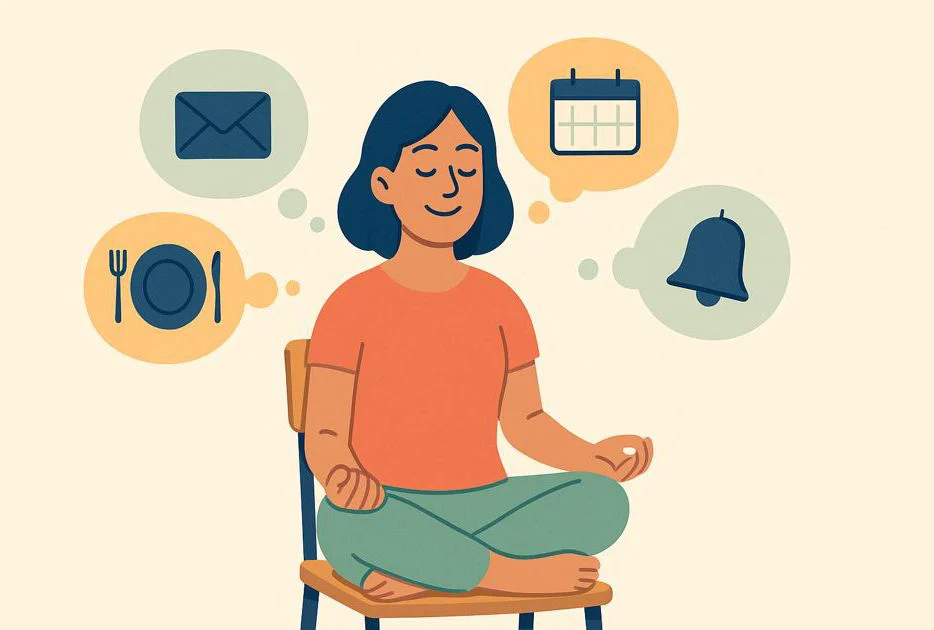
How can it be that we know the motto for exercise: three times a week is enough, more is a bonus – but completely neglect our mental fitness?
Today, I’ll show you why just 2–5 minutes of morning meditation can be as effective as brushing your teeth – and how a simple routine can bring immediate clarity to your day. By the end, you’ll have a 3-step routine that you can try out right away.
But before we start, take a look at how most of us actually start our day in the morning.
Table of Contents
Why mental hygiene is lacking in everyday life

Many of us start the morning on autopilot: our mobile phones vibrate, messages flash up, and our minds immediately turn to appointments, to-do lists and obligations. Without realising it, we don’t give our minds a moment to settle – and that’s exactly what’s often missing in everyday life: conscious mental hygiene. While brushing our teeth is a matter of course for our bodies, consciously starting the day right for our minds usually falls by the wayside. We rely on our minds to function somehow and pay little attention to them, even though the first few minutes after waking up are crucial for our mood and energy levels.
If you’re honest, you would never leave the house without brushing your teeth – even when you’re in a rush. But when it comes to our mental state, we often don’t take it so seriously. Many believe that mental hygiene is a luxury or only necessary when something is already going wrong. However, studies show that our first thoughts in the morning have a strong influence on our mood and the course of the day. If we don’t give our minds a moment to settle, we intensify short-term stress reactions – and scientific research shows that chronic stress can increase inflammation markers such as NF-kB and CRP in the long term and impair sleep. The effects are not the same for everyone, but there are clear indications that those who regularly practise mental hygiene have a more robust nervous system and are less prone to exhaustion or burnout.
-

Anahata Harmony
49,95 € -
Manipura Strength
49,95 € -

Muladhara Balance
49,95 € -
Sahasrara Connect
49,95 € -
Shanti Presence
49,95 €





The image of brushing your teeth helps to illustrate the principle: physical hygiene protects us from tooth decay, mental hygiene protects us from the ‘plaque’ of worries, tension and repetitive thoughts. Imagine you are sitting at breakfast, but you cannot taste your food because your mind is already on the next email. Or you get on the train and already feel restless before the day has even really begun. These are typical signs that your mind has not had a chance to sort itself out. The result: we carry around an invisible layer of tension that builds up throughout the day.
Many people report feeling irritable or exhausted in the morning because they slip straight into working mode without pausing to reflect. Surveys show that the majority of adults often feel drained before noon – especially if the day begins without a clear pause. These patterns are widespread, but they can be changed. Short-term meditation programmes show measurable improvements in stress, sleep and mood after just a few weeks. This confirms how strongly small routines can influence our well-being, even if they only last a few minutes.
You don’t have to completely change your life to do this. It’s enough to incorporate a small but effective habit into your morning routine. Here’s an example that I use myself and often share with others: start the day with two minutes of conscious breathing before you reach for your mobile phone or think about your first task. Breathe deeply through your nose, feel your belly rise, pause briefly – and as you exhale, consciously let go of everything you don’t need. This simple technique signals to your brain: now is the time to sort things out and let go. After just a few breaths, you will feel your stress levels drop and your head become clearer.
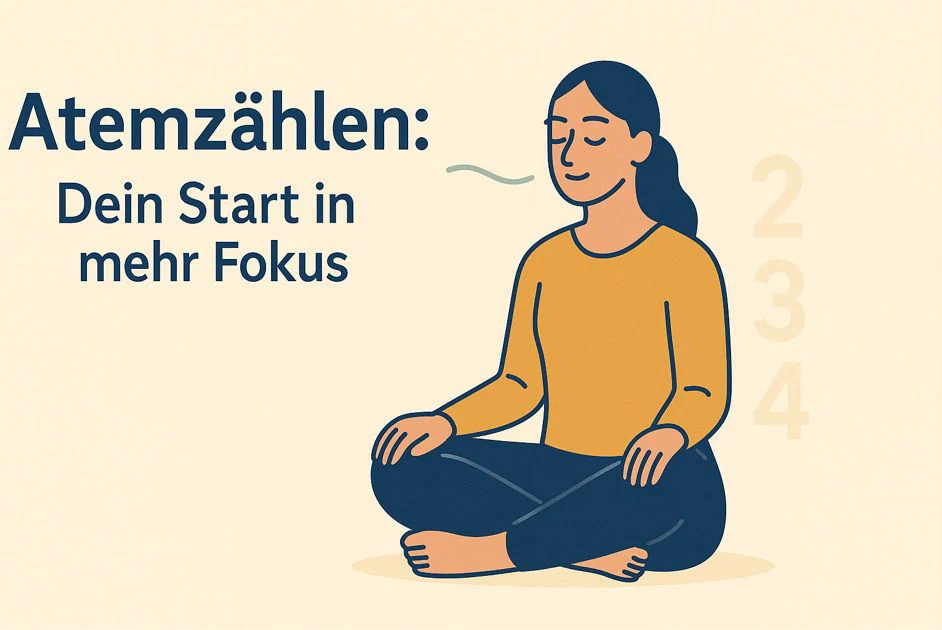
The secret behind breath counting
Here’s a simple test: Sit down comfortably and consciously count three breaths – one when you …
Here, too, the parallel with brushing your teeth is helpful: the short morning routine acts as a protective film, not against tooth decay, but against the negative consequences of rumination and tension. Studies show that this investment in mindful moments leads to greater serenity and energy in the long term. Those who regularly clear their minds protect themselves from everyday stress and ensure that ‘plaque’ from worries and stress cannot build up in the first place.
After a while, you will notice that it is easier to stay calm even in stressful situations – just as healthy teeth enable a carefree smile. The effect is subtle but noticeable: you start the day feeling clearer, more focused and more relaxed.
But what exactly happens in your brain and body when you take these two minutes? Let’s take a look.
What your brain really needs in the morning
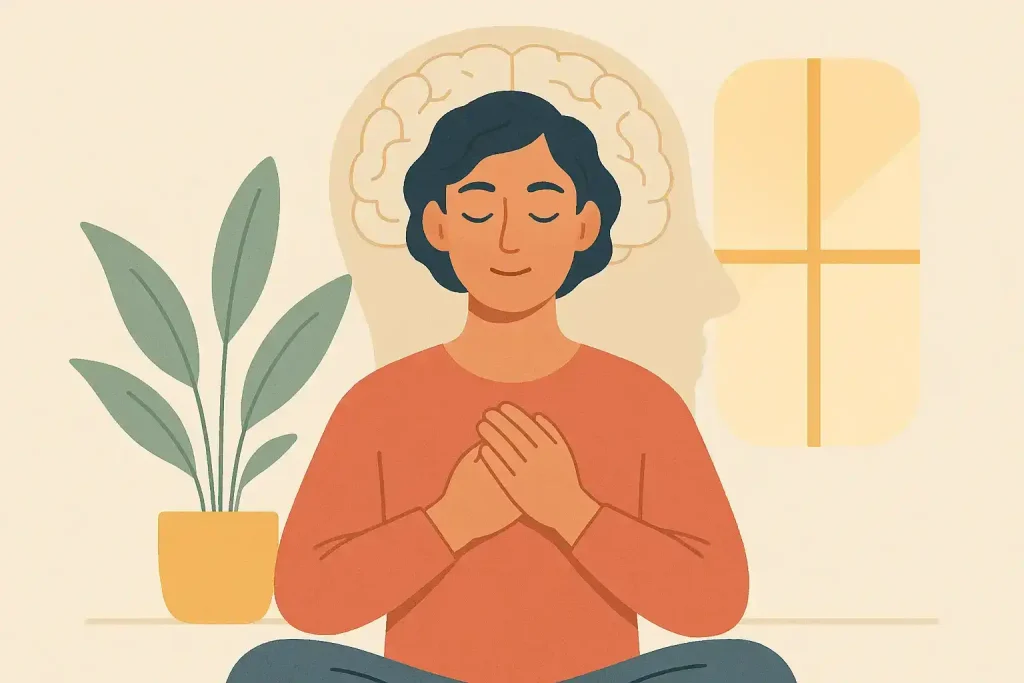
Many people underestimate how much our brain sets the course for the whole day in the morning. What does your mind really need right now? In the morning, the brain is particularly receptive to first impressions; initial thoughts often set the tone for the whole day – studies show that practising mindfulness early in the day can reduce reactivity throughout the day. This means that how you spend the first few minutes after waking up has a significant impact on how you deal with stress, challenges and minor disruptions.
Consider how most of us start our day: the alarm clock rings, your mobile phone is within reach, and suddenly you are caught up in a stream of messages, appointments and to-do lists. Without consciously taking a break, you are on autopilot. This may seem harmless, but in fact two things are happening in your mind:
Firstly, automatic reactions to external stimuli set a basic tone. If the day begins with hectic activity, worries or annoyances, the brain remembers this initial state and builds on it. Secondly, unchecked thoughts – whether stress, doubts or ruminations – repeat themselves throughout the day, reinforcing the feeling of being overwhelmed. If you don’t interrupt this cycle, you will often carry this tension with you into the evening.
You may be familiar with this: one wrong word, a minor traffic jam or some bad news in the morning – and suddenly you feel irritable or rushed, even though objectively nothing major has happened. This is because your mind has not yet properly “arrived”. Unsorted thoughts and feelings can cast a fine film over the whole day. It’s just like brushing your teeth: if you skip it, you’ll eventually feel that something is wrong.
This is where a short, conscious morning routine comes in. Just a few minutes of meditation or breathing exercises can help to interrupt autopilot mode and actively shape your day. Studies have shown that even short daily exercises (e.g. ~10–15 minutes) are enough to improve attention. So you don’t have to meditate for hours to feel the effects – even small routines can make a difference.
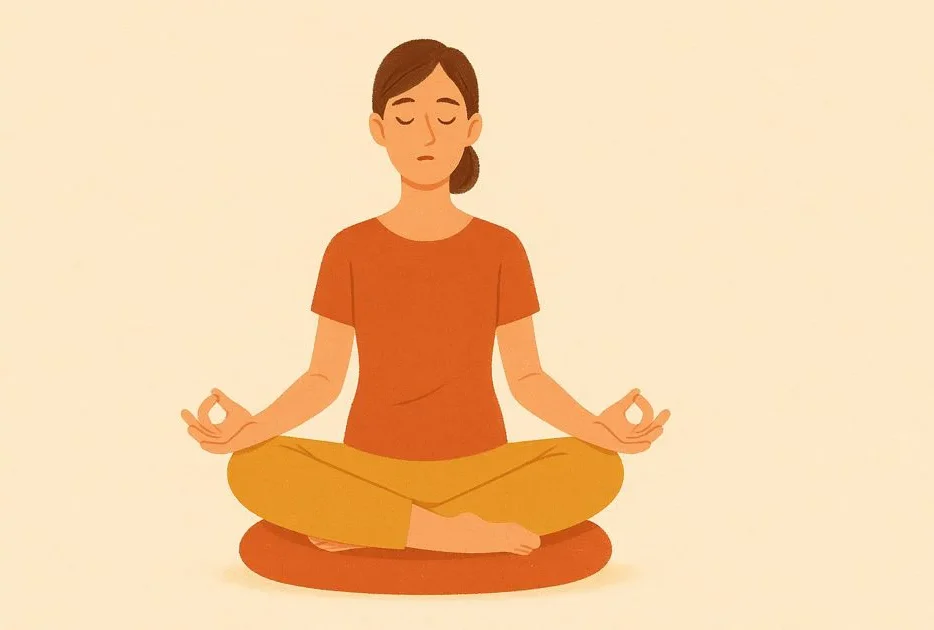
Here is a practical example that you can try right away: After waking up, sit upright, close your eyes and place your hands loosely on your thighs. Now take three to five deep breaths in through your nose and slowly exhale through your mouth. Concentrate only on the rising and falling of your belly. If thoughts arise, acknowledge them but let them pass – like clouds in the sky. After the last few breaths, slowly open your eyes, stretch lightly and only then start with your mobile phone or to-do list. This mini practice works because it interrupts your automatic reaction mode and directs your attention to the moment.
Why does it work? In these few minutes, you give your brain the chance to reset before old patterns take over. You create a clear distinction between sleep and everyday life, prevent negative thoughts from taking hold, and start the day with more inner peace. After just a few days, many people report feeling more balanced and less reactive to external disturbances.
Scientific studies show that regular meditation strengthens your ability to concentrate, perceive emotions more consciously and deal with stress more calmly. This effect is particularly noticeable in the morning because the brain is not yet flooded with external stimuli. With every little morning practice, you train yourself like a muscle: it becomes easier to regulate yourself and consciously shape your day.
Even if you are not a meditation pro, regularity is what counts most. Just two to five minutes are enough to set a new course. It is important that you really take this time before you get distracted by news, social media or appointments. This will gradually create a stable foundation on which you can build the rest of your day.
If you stick to this routine, you will notice that challenges become less daunting, minor annoyances are less likely to throw you off track, and your mind will be clearer overall. Morning meditation is not a cure-all, but it is a reliable anchor that will always bring you back to your centre.
Many people wonder whether this short practice is really enough to cope with everyday stress. In fact, new research shows that meditation can do much more than just relax us – it has an effect on the body and even influences how resilient we are to stress and external pressures.
You may be wondering: Can meditation really be a kind of protective shield against everyday stress?
Meditation as an immune boost and stress protection
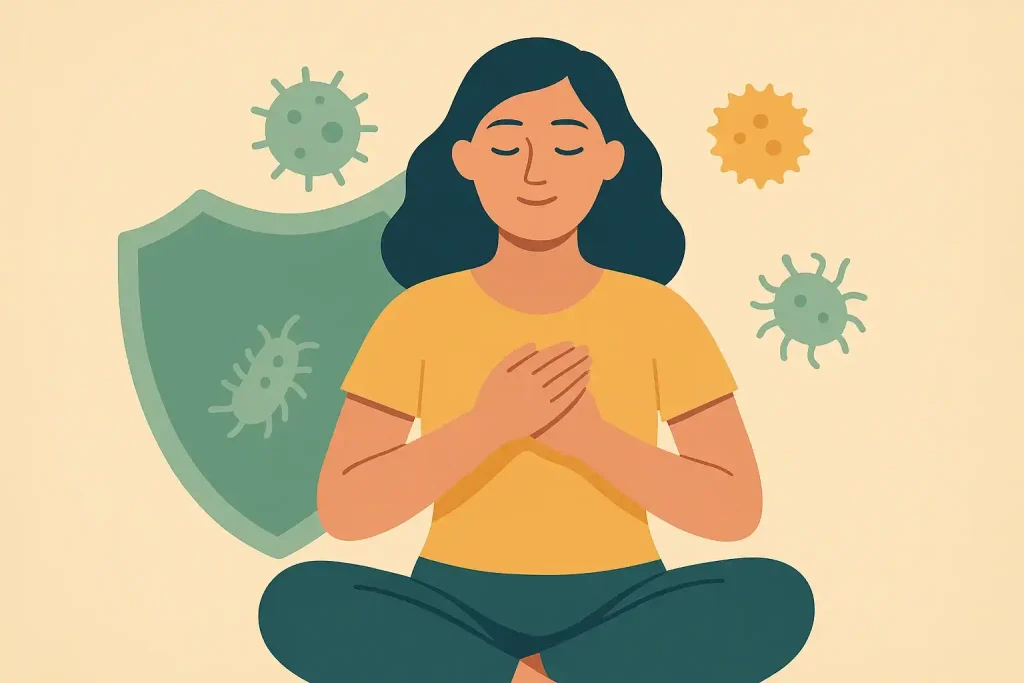
When it comes to meditation as an immune booster and stress protector, many people first think of relaxation and a moment of peace. But the effects of meditation go much further than that. Modern research shows that regular meditation practice not only affects the mind, but also the body – right down to the level of our immune system. However, the picture is more nuanced than it appears at first glance.
If you are repeatedly exposed to minor and major stressors in everyday life – whether due to sensory overload, time pressure or lack of sleep – your body responds with a variety of biological processes. Stress hormones such as cortisol increase, the immune system is activated, and insidious inflammation can develop. Such processes can be detected in the blood via specific markers such as NF-κB, CRP and IL-6. Studies show that meditation can reduce inflammatory signals such as NF-κB and, to some extent, CRP in some randomised, controlled trials. However, the results are heterogeneous; effects on IL-6 are not consistent – scientists refer to promising but not yet fully established immunological effects.
Meditation is therefore not a substitute for medical prevention, but it can modulate stress-related immune pathways and thus support one’s own resilience. This means that those who meditate regularly can help their bodies to react more calmly to stress and recover more quickly when the pressure increases. Several studies report that MBSR courses and short meditation programmes were associated with lower morning cortisol levels and better sleep quality. Sleep in particular is a key factor in regeneration and the immune system – and meditation can make a valuable contribution here.
You may be wondering how you can benefit from these effects without having to sit on a meditation cushion for hours on end. The good news is that you don’t need long sessions to feel the first changes. Short interventions – for example, six minutes of mindfulness or conscious breathing – have been shown in studies to bring acute relief, such as reduced inner restlessness before bedtime. However, the long-term immunological effects develop over weeks to months of regular practice.
A practical example that you can try right away is abdominal breathing. Sit upright in the morning, place your hands on your stomach and gently close your eyes. Breathe in slowly through your nose, feel your belly rise, and breathe out calmly and slowly through your mouth. Imagine that with each exhalation, you are blowing a bit of tension out of your body. Repeat this for ten breaths. This little exercise acts like a reset button for your nervous system. It signals to your body that it is time to slow down and find new stability.
Research suggests that such short, conscious breaks can help to dampen the stress response. People who meditate regularly still experience stress, but their physical reactions are often weaker. Their heart beats more calmly, their breathing remains deeper, and their muscles relax more easily. Consciously perceiving and controlling your breathing is a particularly simple and effective way to calm the nervous system. This creates a kind of buffer zone in everyday life where you don’t have to react immediately to every stimulus.
The important thing is regularity, not perfection. It’s less about the length of the meditation and more about continuity. Even small routines that you incorporate daily or several times a week can make a difference. Many people report that after a few weeks, they notice how they remain calmer in stressful situations and recover more quickly when they lose their balance. The inner pause that you train through meditation will become an integral part of your everyday life over time.
Of course, meditation is not a vaccine against stress or illness. It is not a substitute for medical treatment and cannot prevent infections. But it helps you to cope better with the challenges of everyday life and relieve the strain on your immune system. The effects vary from person to person, but the direction is clear: those who meditate regularly create a stable foundation for themselves and can cushion stress more easily.
-

Muladhara Balance
49,95 € -
Swadhisthana Flow
49,95 € -
Manipura Strength
49,95 € -
Anahata Harmony
49,95 € -
Vishuddha Clarity
49,95 €





Perhaps you have already experienced feeling calmer after a short breathing exercise or being able to fall asleep more easily in the evening. These are the first signs of how meditation works in everyday life – subtle, but noticeable. You don’t need a special occasion or perfect technique. The important thing is that you allow yourself this moment of mindfulness. Research provides a clear message: meditation can help regulate stress responses and support the immune system, even if the effects are not equally strong for everyone.
If you incorporate this practice into your daily routine, you will find that minor disruptions will affect you less and you will become more resilient overall. Just as daily dental care helps prevent problems, meditation protects you from the ‘plaque’ of stress and rumination. And best of all, this investment in yourself is easy, free and available anytime.
But how often should you really meditate to feel these effects? Does it have to be every day, or is a few times a week enough? Let’s take a look at what we can learn from sport about routines and minimum requirements – and how you can benefit in the long term by taking small steps.
How much is enough? The hygiene formula from sport

When we talk about routines, it is worth looking at what has long been proven in sport: regular but realistic minimum effort brings the greatest progress. When it comes to training, exercising three times a week lays the foundation for fitness and health – anything more than that is a bonus, but not a must. This pragmatic view can also be applied to mental hygiene. Many people think that meditation has to be done daily or for a particularly long time in order to be effective. But that’s not true. A practical minimum, which is also supported by studies and programmes, is that even short, regular sessions – for example, three to five times a week for five to fifteen minutes – bring measurable benefits in terms of clarity, serenity and stress resistance. It is not perfection that is crucial, but consistency. Consistency clearly beats occasional marathon sessions.
If you’re wondering whether that’s really enough: yes, there are numerous studies that show that even short interventions – such as app-based programmes or studies involving just a few minutes of daily practice or three sessions per week – already have positive effects on concentration, mood and stress perception. So you don’t need elaborate rituals or hours of sitting. If you meditate for five minutes three times a week, that’s a strong starting point. More is welcome, but it’s not a sign of failure if you can’t do it every day. This takes the pressure off and makes it easier for beginners in particular to stick with it.
I often hear that many people start meditating and quickly feel that they are not doing ‘enough’. This leads to frustration and abandonment. It is much more helpful to set yourself a baseline that remains achievable even during stressful weeks. If three times five minutes per week is realistic for you, then that is your foundation. Anything beyond that is a bonus, but not a must. This attitude takes away the pressure to be perfect and ensures that meditation can become a sustainable habit – just like brushing your teeth every day.
-
Muladhara Balance
49,95 € -
Swadhisthana Flow
49,95 € -
Manipura Strength
49,95 € -
Anahata Harmony
49,95 € -
Vishuddha Clarity
49,95 €
The practice itself can be very simple. Sit upright for a few minutes in the morning, right after waking up or brushing your teeth. Place your hands loosely on your thighs, close your eyes and take a few deep breaths. Feel your body in contact with the chair or cushion. Observe what is going on inside you without judging or trying to change anything. If thoughts arise, let them go and gently bring your attention back to your breathing or your body awareness. Just five minutes is enough to clear your mind and start the day with greater clarity.
You may doubt whether this small dose really makes a difference. But the research is clear: it’s the regularity that counts. Studies show that people who incorporate short meditations into their daily routine for several weeks soon report greater concentration, inner peace and better stress management. Some notice that they react more calmly, brood less or recover more quickly after a stressful day. The key is to establish a fixed routine – just as no one would think of brushing their teeth only when they feel like it.
Of course, you can expand your practice if you enjoy it. Those who meditate more frequently often benefit additionally – but the foundation remains crucial. Just three sessions per week create a ‘hygienic minimum’ for the mind. Anything beyond that is a nice extra – for even more clarity, calm or joy in your practice. If you internalise this idea, there will be less resistance, and meditation will become an integral part of your everyday life.
A common misconception is that meditation only works in the perfect setting – sitting down, in complete silence, ideally with candles and music. In fact, you can meditate anywhere: on the edge of your bed, in the kitchen, even briefly on the balcony. The important thing is that you take this moment for yourself and trust the process. It’s not about technique or sitting posture, but about consciously taking time out for your mind.
Many people in my community report that this simple formula helped them get started – and that the practice has become a much more sustainable part of their everyday lives. Basic mental hygiene protects against the build-up of stress and inner overload. It can be flexibly adapted to any stage of life, no matter how much time you have available. Over time, this short meditation will become a natural part of your day, something you may even look forward to.
Anyone can meditate – no prior knowledge required
Do you think meditation means “thinking nothing” and sitting completely still? Wrong! In…
To get you started right away, here is a little technique: Sit quietly for five minutes in the morning, right after brushing your teeth. Place your hands on your thighs, breathe in deeply through your nose, hold your breath briefly, and breathe out slowly and deeply through your mouth. Count to four as you breathe in, hold your breath for two seconds, and breathe out to six. After a few minutes, you will notice how your head becomes clearer and your thoughts calmer.
These small steps make all the difference in the long run. It’s not about big changes overnight, but about a stable, regular practice that accompanies you through your everyday life. Small routines are more effective than rare, long sessions – this is confirmed by both personal experience and many studies.
Perhaps you have already wondered whether this morning routine can influence not only your day but also your sleep. After all, what you do for your mind in the morning often has an effect that lasts into the evening – and can be decisive in how well you switch off at night.
Meditation and sleep – an underrated team
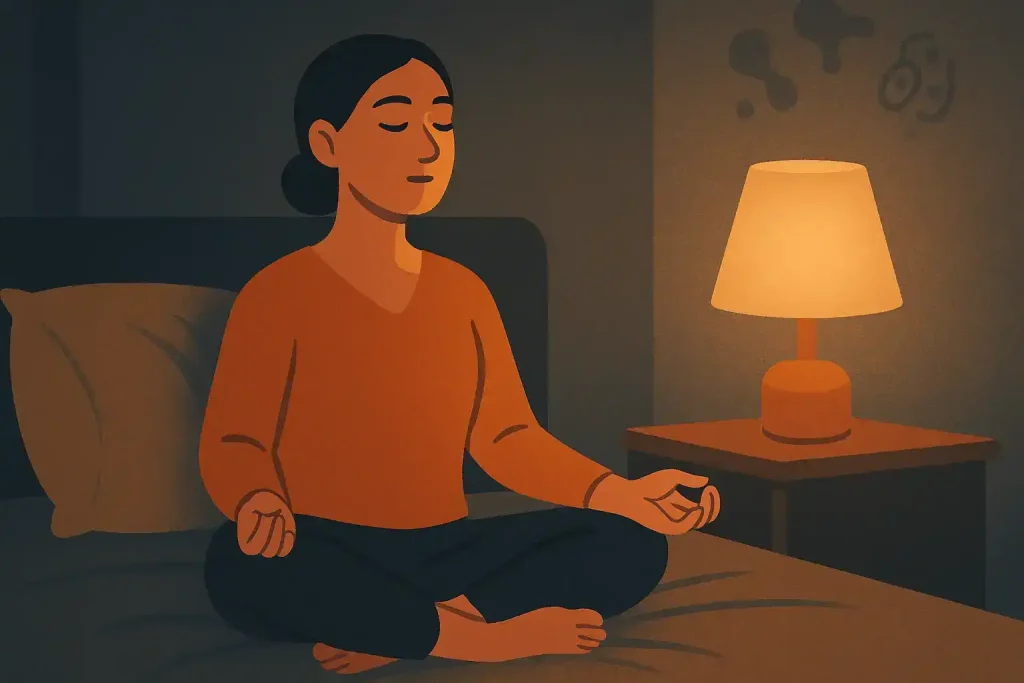
Many people underestimate how closely meditation and sleep are linked. In the evening, we often look for quick fixes to help us sleep better: herbal tea, putting our mobile phone away, perhaps an audiobook to help us fall asleep. What is often overlooked is that the foundation for restful nights is laid much earlier – namely, with a conscious morning routine. The way you start your day, how you deal with your thoughts and whether you allow yourself moments of mindfulness influences how easily your mind finds peace in the evening.
In everyday life, I encounter the same pattern time and time again: many people lie awake at night because their minds won’t switch off. Their thoughts revolve around unfinished tasks, minor or major worries, and the feeling that they haven’t really ‘wound down’ yet. This merry-go-round of thoughts doesn’t come out of nowhere – it often builds up throughout the day, especially if no conscious breaks or a clear start to the day have been planned. Without this inner order, the mind feels like a cluttered desk in the evening: unsorted, chaotic, full of loose ends that disturb sleep.
This is where meditation comes in. It helps you to consciously structure your day and gradually reduce mental stress. Especially in the morning, a short mindfulness practice can lay the foundation for greater inner peace. By meditating for just a few minutes, you signal to your mind: I am starting the day with clarity. This makes it easier to switch off in the evening, because there are fewer unresolved thoughts and residual stress.
Research confirms how effective this combination is. Randomised studies show that even short mindfulness exercises before bedtime can reduce inner restlessness and improve subjective sleep quality – both for beginners and for people with sleep problems. In an experiment with athletes, for example, a six-minute mindfulness exercise after evening training led to them feeling less tense before falling asleep and perceiving their sleep quality as significantly better. Longer programmes such as MBSR also show in studies that regular meditation can reduce sleep disorders and insomnia symptoms. The effects are not limited to specific groups – both people who experience a lot of stress and those who simply want to sleep better benefit from short, regular sessions.
The important thing is that you don’t need complicated techniques or hours of practice. Just a few minutes of conscious breathing or guided meditation are enough to calm the mind and organise your thoughts. In the evening in particular, a short mindfulness routine can help to stop your thoughts from racing and prepare your body for sleep. This can be as simple as sitting quietly for three minutes and concentrating on your breathing: inhale, feel your stomach rise, pause briefly, exhale slowly and consciously let go of whatever is still on your mind with each exhalation. Imagine how with each breath you let go of a piece of everyday life and bring the day to a close.
You can try this little evening routine right away: Before going to bed, sit upright on your bed, close your eyes and focus your attention on your breathing. Breathe in through your nose, feel your stomach rise, pause briefly, and breathe out slowly. As you breathe out, consciously let go of any thoughts and worries that are still on your mind. Allow yourself to leave everything unfinished for tomorrow – there is no need to finish anything tonight. Remain kind to yourself during the exercise and imagine how the day becomes quieter with each exhalation. After three minutes, slowly open your eyes, move around a little and then lie down and relax. Many people report that after just a few days, they find it easier to fall asleep and wake up feeling more rested.

How to find your perfect crystal
Choosing the right stone can be overwhelming at first – there is a huge variety available, and each …
This practice becomes even more effective when combined with a mindful morning routine. Starting the day with mindfulness sends a signal to your nervous system to seek structure and relaxation, which carries through the day and makes it easier to fall asleep at night. Consistency is key: the more often you allow yourself these brief moments, the more stable your inner rhythm becomes, and the better your body can switch between activity and rest.
The connection between meditation and sleep is more than just a nice side effect. It is an underestimated team that helps you reduce stress, consciously shape your day and truly regenerate at night. Even small changes in your routine can have a big impact – for more peace, energy and balance.
However, meditation does not only affect your sleep or well-being. New research shows that regular practice can even reach the cellular level and trigger changes that have a long-term impact on your health.
How meditation affects your genes and ageing
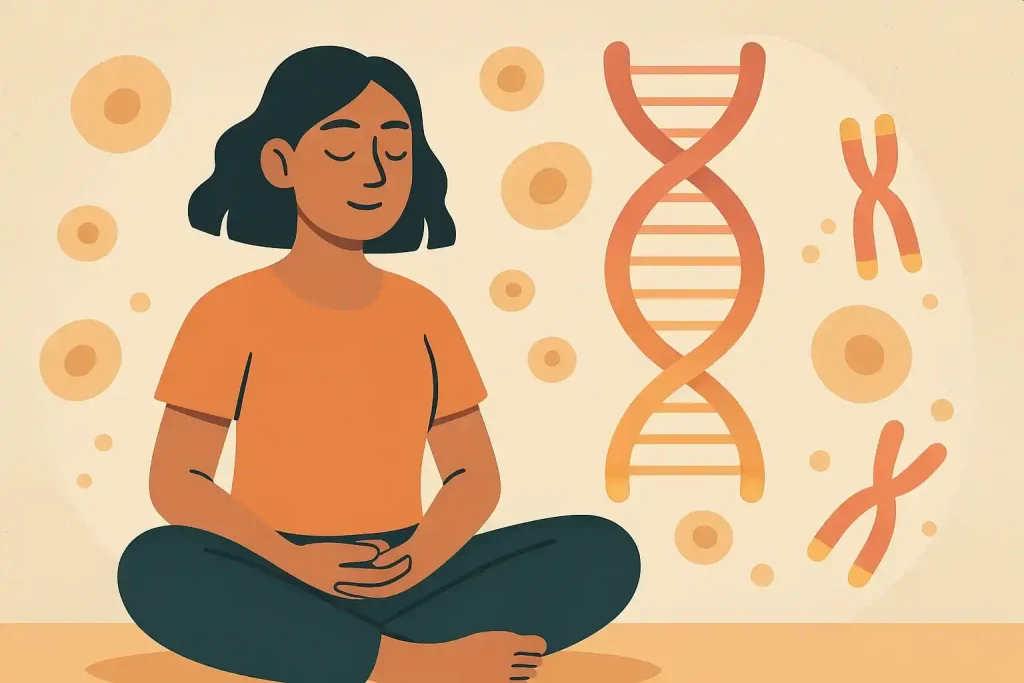
Many people are surprised to hear that meditation not only enhances well-being, but can also influence processes related to ageing and health at a deeper level. Most people associate meditation with relaxation, inner balance or better stress management. But in recent years, research has begun to take a closer look at how regular mindfulness practice can even influence biological processes in the body – for example, when it comes to ageing and the resilience of your cells.
A key topic here is telomeres. These are small protective caps at the ends of your chromosomes, comparable to the plastic ends of shoelaces. Their job is to protect your genetic information during each cell division. Telomeres shorten with age, which is considered a natural part of the ageing process. Interestingly, in some studies, researchers report that people who meditate regularly have higher telomerase activity – this is the enzyme that repairs and lengthens telomeres. There is also evidence of a link between meditation practice and longer telomeres. However, these results are not consistent. Some studies find this link, others do not. Scientists agree that there are initial, promising indications, but the exact effect and significance have not yet been conclusively clarified. Therefore, these effects should be considered a possibility, not a definite promise. Some studies report increased telomerase activity or associations with longer telomeres in meditators, and there is initial evidence of epigenetic changes related to stress pathways. However, the results are mixed, and more research is needed to determine the cause and extent of the effects with certainty.
-
Vishuddha Clarity
49,95 € -
Shanti Presence
49,95 € -
Sahasrara Connect
49,95 € -
Muladhara Balance
49,95 € -
Swadhisthana Flow
49,95 €


In addition to telomeres, there is another exciting area: epigenetics. This concerns the ‘switches’ on your DNA that influence which genes are active and which are not. Meditation also seems to influence these switches – especially when it comes to inflammation and stress regulation. Meta-analyses and randomised studies show that meditation can alter gene expression related to inflammation and stress (i.e. epigenetic markers). But here, too, the results vary depending on the study design and the group studied. It cannot be said across the board that meditation has the same effects on everyone or that these changes are always significant. Nevertheless, it is impressive that such a simple practice as meditation can leave detectable traces at the molecular level.
What does this mean for you in everyday life? In short, meditation can help support processes related to healthy ageing, stress regulation and immune defence. Research suggests that in some people, markers of cellular ageing decline more slowly – but this is not a universal rule. It is more of a tendency than a guaranteed rejuvenating effect. More importantly, regular meditation gives your body and mind the chance to regenerate and build resilience.
The immune system also benefits from consistent meditation practice. Several studies have shown positive changes in immune cells and inflammation levels. There is evidence that even short, regular sessions – for example, five to fifteen minutes – are sufficient to support these effects. But here, too, the results are not always clear-cut and depend on many factors, such as the duration and type of meditation, lifestyle and individual circumstances.
A particularly accessible introduction to this practice is Metta meditation, also known as loving-kindness meditation. It is suitable for beginners and advanced practitioners alike and combines mindfulness with an attitude of compassion – for oneself and others. Feel free to try it out right away: sit comfortably, close your eyes and take a few deep breaths in and out. Then repeat a simple phrase internally, such as: “May I be healthy and calm. May I remain kind to myself.” This little exercise not only boosts your mood and promotes compassion, but also ties in with research findings that show that such practices can enhance well-being and increase positive feelings in everyday life. It is a biopsychosocial approach: you are doing something good for your mind, body and social environment – and all it takes is a few minutes a day.
If you practise this metta meditation regularly, you may notice that you react more calmly to stress and that compassion – both for yourself and for others – flows more easily into your everyday life. Studies show that precisely such changes can also be measured on a biological level, for example through altered stress markers or positive effects on the immune system. The key here is not perfection, but continuity. It is not important whether you meditate for half an hour every day, but that you regularly allow yourself small moments of mindfulness.
What is the heart chakra?
Many people talk about the heart chakra, but hardly anyone knows how it really feels in their everyd…
In summary, meditation is much more than just a relaxation technique. It can have an effect on various levels – from mood to cellular processes associated with ageing and health. Research provides ample evidence that regular practice is beneficial. However, it also makes it clear that meditation is not a substitute for medical treatment and is not a panacea. Rather, it is a sustainable investment in your well-being and resilience – and one that requires a manageable amount of effort.
You may be wondering why, despite all these benefits, meditation is still not a matter of course for many people. While routines such as brushing your teeth or showering are an integral part of everyday life, meditation is often still considered optional. Why this is the case – and how you can integrate meditation into your day as naturally as other daily habits – is the subject of the next section.
Why meditation should become a matter of course
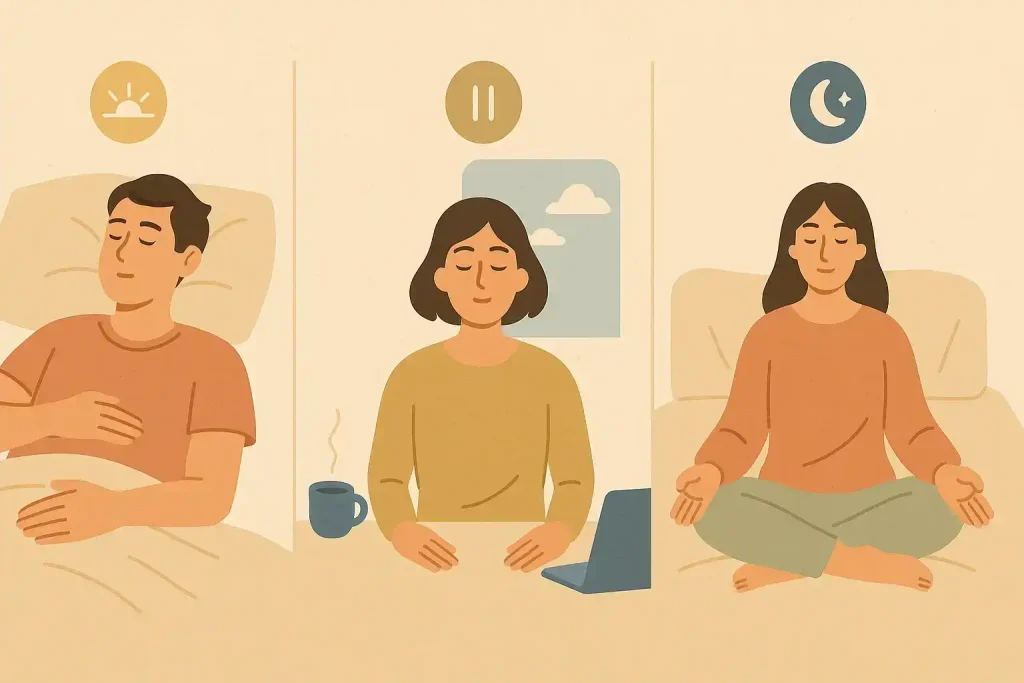
Imagine starting your day with meditation as naturally as you reach for your toothbrush. For most of us, brushing our teeth in the morning is an integral part of our routine – we do it automatically, without giving it much thought. We simply know that it is important, that it protects us and makes us feel good. Meditation, on the other hand, remains a vague intention for many, quickly superseded by other priorities. Yet scientific findings speak for themselves: those who meditate regularly benefit in a similar way to those who brush their teeth daily – not spectacularly overnight, but noticeably and sustainably.
Why is it still difficult for us to establish meditation as a natural routine? According to research, in addition to a lack of habit, three factors play a particularly important role: lack of time, scepticism about the benefits, and the fear of doing something wrong or not being able to meditate “properly”. These hurdles come up again and again when people are asked why they don’t start or stick with mindfulness practice. Many believe that meditation is complicated or requires special conditions. But it is much easier than often thought.
It helps to think of meditation as a form of mental hygiene – just as natural as taking care of your body. Every day, our minds are exposed to new stresses, pressures and sensory overload. Without conscious cleansing, worries, tension and negative thoughts settle like an invisible film. Those who meditate regularly ensure that this ‘plaque’ does not build up in the first place. And best of all, just a few minutes a day are enough to achieve this effect.
-
Muladhara Balance
49,95 € -
Swadhisthana Flow
49,95 € -
Manipura Strength
49,95 € -
Anahata Harmony
49,95 €
Research and experience in behavioural psychology clearly show that small, repeated habits have the greatest effect – not infrequent, long sessions. Just two to five minutes a day, right after getting up, can be enough to make meditation a part of your daily routine. The key is repetition, not the duration or perfection of the practice. Just like brushing your teeth, regularity is what counts. Taking a few minutes in the morning lays the foundation for greater inner peace and clarity throughout the day.
A practical tip for integrating meditation into your daily routine: link it to an existing habit, for example, right after brushing your teeth. This way, you can take advantage of the so-called ‘habit stacking’ effect: a new habit is linked to an already established one. This makes it easier for you to stick with it because the routine is already part of your morning. After brushing your teeth, take two to five minutes to sit comfortably, close your eyes and focus your attention on your breathing. Feel yourself breathing in and out, and simply let thoughts come and go without holding on to them. This short break is enough to give your mind a clear start.
Many people report that this mini routine gives them more serenity, concentration and energy in their everyday lives. It’s not about expecting big changes right away. The effects are subtle: you are less irritable, can cope better with stress and find your centre more quickly when something throws you off track. Step by step, meditation becomes a natural part of your basic hygiene – not as a luxury, but as the basis for mental health.
Anyone can meditate – no prior knowledge required
Do you think meditation means “thinking nothing” and sitting completely still? Wrong! In…
A common misconception is that meditation should only be practised when stress levels are already high. In fact, it works best when used preventatively, like brushing your teeth. It strengthens your resilience and allows you to take precautions rather than just reacting in an emergency. Over time, it becomes a stable anchor in your everyday life that supports you even in hectic phases.
You may be thinking, ‘Two minutes – will that really do anything?’ The answer is clear: yes. Researchers and behavioural experts agree that small, regular sessions are more effective for building a new habit and achieving measurable results than infrequent, long sessions. It is this consistency that makes the difference, not the length of each meditation session.
To make meditation a natural part of your life, it helps to lower your expectations. It doesn’t have to be perfect, and you don’t have to do everything right. The important thing is to start and stick with it. With each passing day, the new routine will become more natural until it is as normal as brushing your teeth in the morning. The more often you meditate, the more it will become part of your everyday life – and at some point, you will no longer ask yourself ‘why,’ but simply do it because it is good for you.
If you’re wondering how to integrate meditation into your morning routine in a practical way without too much effort, you’re not alone. This is exactly where many people fail because they want too much at once or think it requires special discipline and perfect conditions. But all you need is a simple, clear structure to get started right away and feel the first signs of success.
How exactly do you incorporate something like this into your morning routine? Here is a three-step routine.
How to get started: The 3-step morning routine
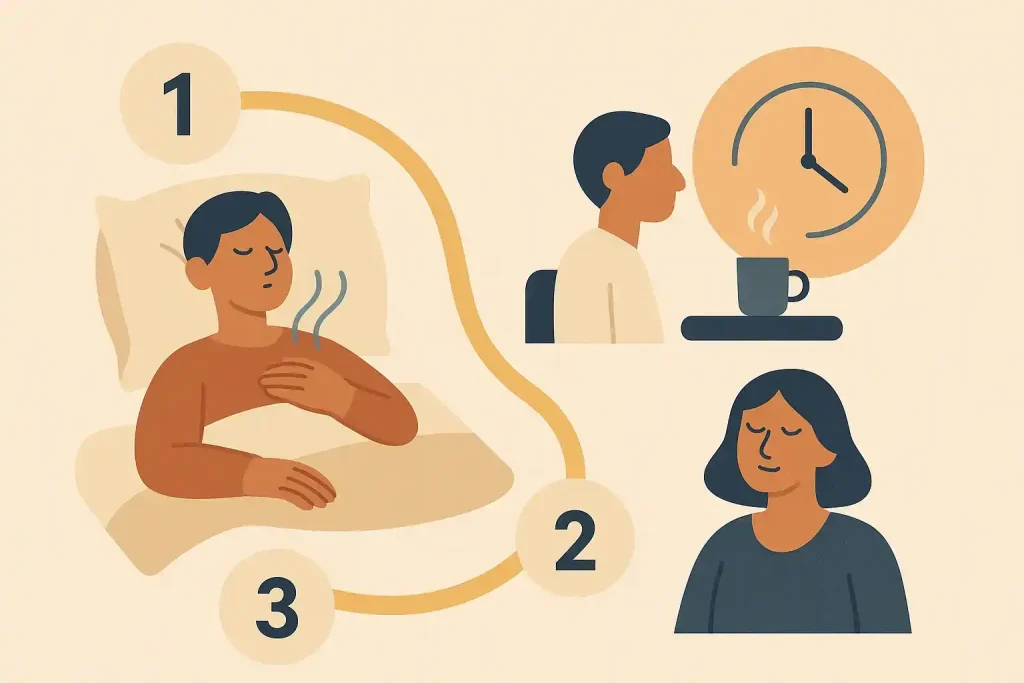
Many people make meditation unnecessarily difficult because they think about perfect conditions: absolute peace and quiet, plenty of time, perhaps even their own meditation room. But in real life, mornings often look different – appointments, family, perhaps even the first glance at your mobile phone. That’s exactly why a simple, clear routine that you can easily integrate into your everyday life is important. Here are three steps that have proven themselves and that you can try out right away. Short, practical and designed to really suit every morning.
Step 1: Morning breath. After getting up, sit upright, preferably still in your pyjamas or on the edge of the bed. Place your hands loosely on your thighs. Close your eyes and focus your attention on your breathing. Take five slow, deep breaths into your belly and exhale. Feel your breath coming and going without changing anything. If thoughts arise, just let them pass. After the five breaths, open your eyes and start your day. This takes less than two minutes – and is the easiest way to get yourself sorted in the morning.
Step 2: Evening break. Before you go to sleep, take another moment to sit quietly. Close your eyes, place your hands on your stomach or thighs. Take three deep breaths in through your nose and slowly out through your mouth. Observe how the day lets go and your body calms down. It’s not about stopping all thoughts, but simply letting them go. After these three breaths, you are ready for the night – with a clearer head and less inner turmoil.
Step 3: Everyday anchors. Throughout the day, use short breaks as mini-meditations. This could be at traffic lights, while waiting for the bus or before your next appointment. Pause for a moment, feel your feet on the ground, and consciously breathe in and out once. These micro-moments help you to reconnect with yourself and interrupt stress. The more often you set such anchors, the easier it will be for you to remain calm even in hectic situations.
Why do these three steps work so well? Studies show that even short, regular mindfulness exercises can reduce stress levels and improve concentration. Clinical studies and app-based programmes prove that even a few minutes of guided meditation or micro-practices make a difference – so they are scientifically proven. It’s not about perfection, but about taking small, repeated breaks for your mind.
To give you a feel for how easy it is, let’s do the short exercise from step 1 together. Sit upright and gently close your eyes. Breathe in and out slowly into your belly five times. Keep your shoulders relaxed and feel how a little more tension leaves your body with each exhalation. Then slowly open your eyes. That’s it. Now take 60 seconds to try it out and write in the comments how it felt for you. This way, you can share your experience and motivate others to try it too.
Perhaps after this mini exercise, you will already notice a small change – more calmness, a clearer head, or simply a moment’s pause. This is exactly how a new habit begins: not with big goals, but with small, achievable steps. Don’t expect immediate miracles, but give yourself permission to simply try it out and see what happens. Each time you do this, you train your “mindfulness muscle” a little more.
Meditation: Why you need to start NOW
Imagine your head is like a laptop that has been running for far too long without a break. Everythin…
Many report that this three-step morning routine helps them start the day feeling noticeably more relaxed, switch off better in the evening and remain calmer throughout the day. It’s not rocket science and doesn’t require any special talent – just the willingness to give yourself these brief moments. Even if you miss a day or get distracted, the important thing is to keep coming back and carrying on. Step by step, meditation will become a real habit that sustains you.
Over time, you will notice that these little islands of calm are changing your everyday life. You feel less rushed, react more consciously and find your centre more quickly when things get stressful. The routine becomes as natural as brushing your teeth in the morning – a solid anchor you can rely on.
If you wish, you can gradually expand or adapt the three steps. Perhaps you could lengthen your breaths, try guided meditations or incorporate small physical exercises. The important thing is to stick with it and make the practice your own ritual. Over time, this will create a stable foundation for greater clarity, energy and inner peace – day after day.
That’s exactly what real morning hygiene is all about: it’s not a luxury, but a basic requirement for well-being and mental health. Starting your day this way lays the foundation for more ease and serenity – and thus invests in a healthier morning.
Your new morning hygiene routine for body and mind

Your new morning routine for body and mind begins with small, clear steps. Studies show that regular short meditation improves attention, mood and sleep – this small investment pays off.
Here are the three most important points to get you started: First, set yourself a minimum of 5 minutes 3 times a week. Second, try two minutes of conscious breathing tomorrow after you get up. Third, share your experience in the comments below – this will motivate you and others.
If this has been helpful, please subscribe to the channel for more tips. It’s simple – just two minutes tomorrow, for yourself. That’s all.
FAQ – Questions about mental hygiene
Why is morning meditation so effective?
Because the brain is particularly receptive to new impressions in the morning. Just a few minutes of meditation can have a positive effect on mood and stress responses.
Are 2 minutes of meditation really enough?
Yes. Studies show that short, regular sessions have measurable effects on concentration, sleep and stress reduction – regularity is crucial.
How does meditation help with mental hygiene?
It’s like brushing your teeth for the mind: your thoughts stop spinning and tension melts away, leaving you feeling clear-headed and calm.
Does meditation also support the immune system?
Yes, research indicates that meditation can lower inflammation markers and regulate the stress hormone system – not a substitute for medicine, but a valuable supplement.
How does meditation affect sleep?
Regular practice makes it easier to switch off in the evening, reduces inner restlessness and improves sleep quality.
What is the best way to incorporate meditation into my daily routine?
Use ‘habit stacking’: meditate immediately after brushing your teeth or combine it with fixed moments of the day. This will make it a fixed habit.

