

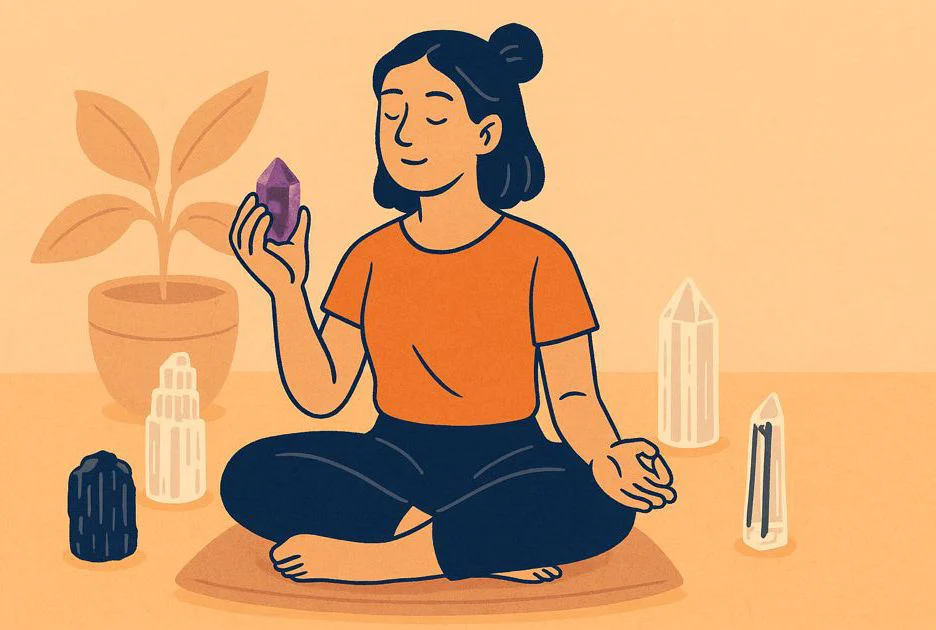
Many people say that meditation with crystals is just esotericism—but recent studies on mindfulness show how regular practice changes our brain and reduces stress. Important: The research clearly refers to meditation and mindfulness exercises, not to the effect of crystals themselves. Research shows that even short, regular mindfulness exercises reduce stress and improve sleep—here we use these findings in a practical way and combine them benevolently with crystal rituals as an anchor.
Many people use crystals as meaningful companions in their practice, helping them to focus on the ritual and their own intentions. Today, you will learn how stones such as amethyst and tiger’s eye can enrich your meditation—in a practical way that is relevant to everyday life. At the end, you will find an immediately applicable grounding and protection exercise with black tourmaline that you can try out right away.
Why do so many people think that meditation and crystals are opposites?
Table of Contents
Science and tradition: two paths, one goal?
Many people reach a point where they ask themselves: What really helps me to find peace? Perhaps you know this feeling yourself—everyday life becomes too much, your thoughts go round in circles, and you look for a way to find yourself again. This often raises the question of whether meditation alone is enough, or whether crystals can actually make a difference in practice. It often seems as if you have to choose: either you rely on scientifically proven methods such as guided mindfulness meditations from apps or courses, or you turn to ancient traditions involving gemstones, incense, and rituals. It quickly feels as if there is only “thinking clearly” or “feeling with your heart” – but not both together.
Let’s take a closer look at this apparent contradiction. On the one hand, there is mindfulness practice, which has now been the subject of numerous studies. Research shows that regular mindfulness exercises can reduce stress and sleep problems and even change areas of the brain associated with attention and emotion regulation. Even short, guided meditations—about six minutes before bedtime—have been shown in studies to reduce the time it takes to fall asleep and improve sleep quality. This is measurable, verifiable, and gives many people a sense of security because effects such as less rumination, better concentration, and greater serenity are also noticeable in everyday life.
Popular products
-

Muladhara Balance
49,95 € -
Swadhisthana Flow
49,95 € -
Manipura Strength
49,95 € -
Anahata Harmony
49,95 €


On the other hand, there are crystals, which play a role in many ancient cultures. Amethyst, rock crystal, rose quartz—they appear in ancient texts and are attributed with certain properties. This is less about objective measurements and more about personal experience, feelings, intuition, and the belief that energy can flow even if we cannot see it. While the effectiveness of mindfulness exercises has been proven in numerous studies, the mechanisms of action of crystals have not been empirically tested in the same way. However, many people experience real, subjective effects – through ritual, intention, and concentration.
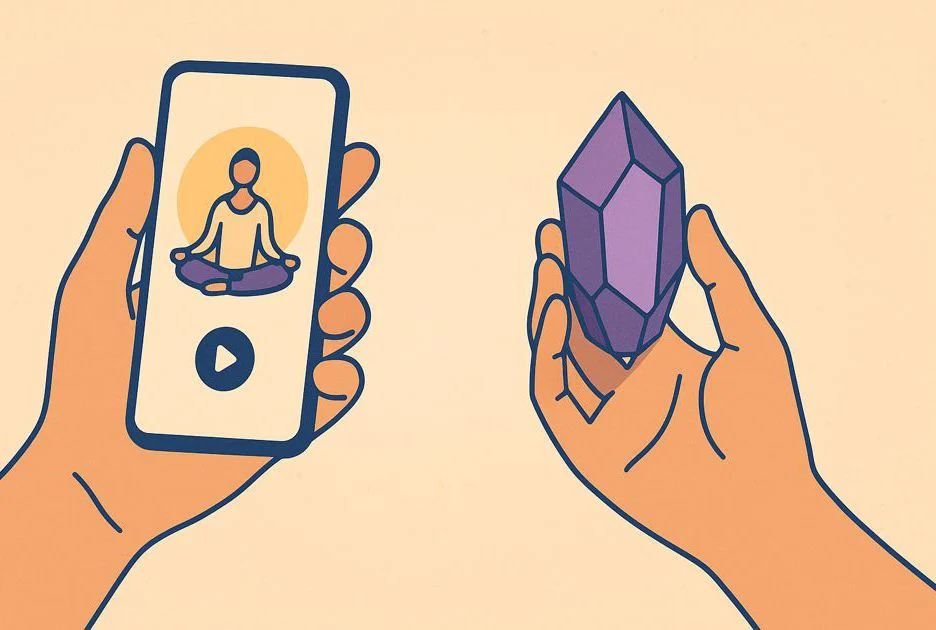
Here’s a quick example from everyday life: After a busy day, you sit down to relax. In one hand, you hold your smartphone and start a guided meditation, and in the other, you hold an amethyst that you received as a gift. Maybe you have a candle burning or some incense. You feel that both—the clear instructions and the little ritual—are doing their part. It’s not about what’s “right,” but what works for you and supports you.
The fascinating thing is that both approaches—the scientifically based approach and traditional practice—often lead to the same goal. People report feeling significantly more relaxed after a short breathing exercise in an app. Others find that meditating with a crystal quietens the noise of their thoughts and brings them more peace. The focus is always on the desire for clarity, serenity, and stress reduction. There are programs that teach mindfulness and show measurable results, such as participants feeling more relaxed after a course. At the same time, we hear many personal accounts of how crystal rituals lighten the heart or bring inner peace.
But why are these two approaches often presented as incompatible? One reason is certainly our need for evidence and visible results. The effects of mindfulness meditation can be demonstrated by brain scans or stress levels in the blood, for example. There are no such laboratory results for crystals. Nevertheless, many people report genuine experiences—warmth, security, lightness. Science refers to this as subjective well-being. Ultimately, what counts is what you feel.
In modern mindfulness training, researchers are increasingly emphasizing the role of intention—that is, your inner focus—in the success of an exercise. Whether you meditate with mindfulness or crystals, as soon as you are consciously engaged and create a safe environment for yourself, the effect becomes more intense. The setting is not esoteric nonsense, but has been proven to be crucial. Studies show that simply consciously preparing the space, lighting a candle, or holding a stone can deepen the experience. For many, this ritualization is what makes meditation—with or without crystals—special. Perhaps you know this yourself: if you just quickly “meditate somehow,” the feeling often remains superficial. But if you create space, light a candle, choose a stone, and consciously take your time, the atmosphere changes immediately.
It would be too simplistic to simply juxtapose the two. In reality, there are many points of contact. People who meditate for half an hour with a crystal on their heart after a stressful week often describe a special connection to the moment—almost like an anchor that brings them into the here and now. People who concentrate entirely on their breath or a body scan while meditating report similar experiences. There are even many who combine the two: they use breathing techniques from mindfulness while holding a crystal to focus even more strongly on energy and clarity.
This combination is not necessarily logical, but for many it is suitable for everyday use and makes sense. This is precisely where the bridge between classical meditation and crystal practice is formed. It does not have to be “either/or.” Anyone who has explored the effect of their own focus knows that the more meaning and intention we give to a practice, the deeper the experience becomes. This is confirmed not only by ancient traditions, but also by modern psychological findings. Placebo effects show that conviction and ritual awareness often determine how relaxing an exercise is—regardless of whether a stone is scientifically effective or not.
So if you’re wondering how these two approaches can work together, it’s worth taking an open-minded, curious look. The strength lies in using both worlds in a practical and meaningful way. Even if you’re skeptical, it may be worth trying both. For me, it has become clear time and again that only when setting, intention, and mindfulness come together does the depth that many seek emerge. This synergy brings more peace, clarity, and stability—regardless of how many studies there are on the subject.
In the next step, we will take a closer look at what actually happens in the brain when you meditate regularly and which processes play a role in this.
What meditation really changes in the brain
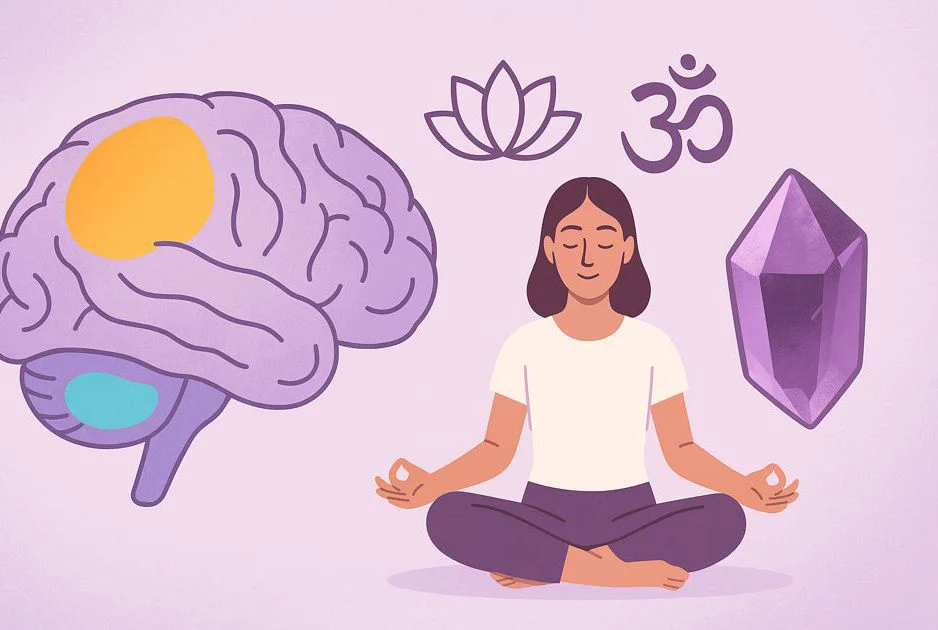
When we look at what regular meditation actually does to the brain, it quickly becomes clear that it is not just a subjective feeling of relaxation, but rather processes that are measurable and comprehensible. Meditation is associated with demonstrable changes in certain regions of the brain. Particularly affected are the prefrontal cortex, which is responsible for attention and decision-making, and the hippocampus, which controls our memory and emotion regulation. The amygdala, which is responsible for stress responses, also shows changes with regular practice—its activity often decreases, which manifests itself in less irritability and more serenity.
The prefrontal cortex primarily strengthens the skills you need in everyday life: planning, reflecting, setting priorities, and concentrating on one thing. Studies show that regular meditation increases activity in this area and can even slightly increase its volume. This means that over time, you will find it easier to focus, solve problems, and keep a cool head even under stress.
What is the crown chakra?
Do you know the feeling that despite morning meditation or short breathing exercise you are always i…
The hippocampus is another fascinating area. It plays a central role in memory and helps you process emotional experiences. Research shows that people who meditate regularly often have a larger volume in this area—a sign that meditation “trains” the brain in a way that has a positive effect on your emotional stability and memory. Particularly interesting: in older people, meditation slows down age-related decline in these brain regions. This means that the brain remains flexible and adaptable for longer.
The amygdala, often referred to as the “alarm center” of our brain, is responsible for fear and stress. Studies show that regular meditation practice can reduce the activity of the amygdala. This means that you react less strongly to stress stimuli and can calm down more quickly. Many people report that after a few weeks of meditation, they are able to deal with conflicts more calmly and are no longer so easily upset.
There are also initial small studies that describe changes in the pineal gland. This gland is located deep in the brain and is responsible, among other things, for the production of the sleep hormone melatonin. The results so far suggest that mindfulness practice may have an influence on certain markers in the pineal gland. However, this is preliminary and not yet an established result—research is still in its infancy. For you as a practitioner, this means that the known effects on sleep and well-being can be explained primarily by the above-mentioned regions, not by the pineal gland alone.
Another important topic is the stress hormone cortisol. Too much cortisol in the blood makes you feel tense, restless, or even exhausted. Meditation can help lower cortisol levels. Studies show that after just a few weeks of daily practice, levels are measurably lower. At the same time, the calming neurotransmitter GABA increases, promoting inner peace and concentration. These changes are not only visible in the laboratory, but are also noticeable in everyday life: you sleep better, are less irritable, and find it easier to relax.
You may be wondering what this feels like in practice and how you can experience these effects for yourself. There are simple, evidence-based exercises you can try out anytime. Studies show that even very short, guided mindfulness inductions—i.e., short meditation sessions lasting one to three minutes—can noticeably improve your sense of calm and help you switch off before going to sleep. Let’s try one of these exercises together.
Sit comfortably and close your eyes if you like. Now breathe in slowly through your nose for four seconds. Hold your breath for a moment—about one second—and then breathe out through your mouth for eight seconds. Repeat this rhythm for two minutes. Focus entirely on the sensation of your breath: how the air feels as it flows in and how it leaves your body. After a few rounds, you will probably notice your heartbeat slowing down, your shoulders dropping, and your thoughts slowing down. You can use this little exercise whenever you need to relax quickly—in the morning, in the evening, or in between everyday activities.
With these short breathing exercises, you not only train your mind, but also support the regeneration of your nervous system. Many people report that after just a few days of regular practice, they sleep better, worry less, and feel more relaxed overall. This technique is particularly helpful if you often lie awake before falling asleep with your thoughts racing. Conscious breathing signals to the brain that it can now switch to rest mode. This is no coincidence, but rather the result of the changes in the brain and hormone balance described above.
The effects of meditation extend beyond the actual practice time. You become more attentive to your own needs in everyday life, recognize stress early on, and can take targeted countermeasures. Many people find that they are not only more focused, but also kinder and more compassionate towards themselves. This has a lot to do with the principle of neuroplasticity—the ability of our brain to change repeatedly through new experiences and habits. Every time you meditate, you strengthen the connections between the areas of the brain responsible for calmness, clarity, and self-regulation.
The beauty of it is that it doesn’t require hours of sessions or complicated techniques. Just a few minutes of conscious breathing a day can make a difference. This lays the foundation for greater inner stability and clarity—regardless of whether you choose traditional meditation, an app, or a supportive ritual with crystals. The key is to take the time regularly and make the practice an integral part of your everyday life.
Perhaps you have already experienced how difficult it can sometimes be to calm your “monkey mind” – that constant restlessness and racing thoughts. This is where supportive elements such as crystals come into play, serving as anchors. Amethyst in particular is often chosen when it comes to clarity and peace of mind. You will find out why this is and how you can meaningfully integrate this stone into your practice in the next section.
Amethyst: Clarity of mind, calmness in the moment
Amethyst is considered one of the most well-known companions in meditation practice. Many people report feeling mentally clearer and calmer with an amethyst in their hand or on their forehead. This feeling is often described as a slow clearing, in which thoughts that were just a moment ago erratic gradually become quieter. It is as if someone were gently turning down the volume control in your head—and small, silent pauses arise between thoughts.
When you want to focus on your breathing but your thoughts keep wandering, many people reach for an amethyst. Traditionally, amethyst is believed to promote clarity and bring order to mental confusion. In many cultures, it has been used for centuries as a stone of clarity and spiritual purification. Classically, you place it on your forehead or hold it in your hand during meditation. Some people imagine a gentle purple light flowing through their head. Others place the stone in the center of their meditation cushion to focus the energy in the room.
Popular products
-
Muladhara Balance
49,95 € -
Swadhisthana Flow
49,95 € -
Manipura Strength
49,95 € -
Anahata Harmony
49,95 €
There are numerous personal accounts in which people describe how they find it easier to calm down by consciously incorporating an amethyst. One customer, for example, told me that she often couldn’t switch off when she was brooding. She tried placing a small amethyst on her forehead, breathing calmly and imagining a violet light flooding her head. After a few minutes, she noticed that her thoughts became less demanding and she felt more centered. For her, the amethyst became an anchor that helped her focus her attention and bring her mind to a place of calm.
It is important to note that the effects described are based on subjective experiences and traditional attributions, not on scientifically proven effects of the stone itself. However, research shows that rituals and physical anchors such as stones can help to focus attention. Studies show that incorporating an object into your practice in a targeted manner helps to direct your attention—a key factor in meditation. Holding a stone, consciously touching it, and the intention associated with this action strengthen your presence in the moment.
Your inner attitude is crucial to the effect. It is not enough to simply pick up a stone and expect everything to change on its own. Only when you really take the time to engage in the practice and set a clear intention does the ritual unfold its power. This applies to every mindfulness exercise: the more consciously you focus, the deeper the experience can become. Many people report that after just a few minutes, they feel their mind becoming calmer as soon as they hold the stone and concentrate on their breathing.
Traditionally, amethyst is associated with the crown chakra and the forehead chakra. These energy centers represent mental clarity, intuition, and connection to something greater. Many people use amethyst specifically to address the area between the eyebrows or at the top of the head. This can help to connect meditation with a certain quality—such as greater alertness, expansiveness, or insight.
So that you can try out the effect for yourself, here is a clearly structured micro practical tip that you can use at any time:
Practical tip: Meditation with amethyst
Step 1
Sit comfortably and hold the amethyst in your hand or place it gently on your forehead.
Step 2
Close your eyes and take six deep breaths through your nose, consciously feeling the weight and coolness of the stone.
Step 3
Imagine a gentle purple light flowing through your head from the top of your head, calming you down.
Step 4
Stay in this silence for one to two minutes, feel inside yourself, and simply let your thoughts come and go without holding on to them.
When your thoughts wander, gently bring your attention back to the stone and your breath. At the end, slowly open your eyes and notice how your mind and body feel. You can incorporate this short exercise whenever you notice that your head is too full or you quickly lose yourself in everyday life.
Many report that this practice helps them achieve a state of calm more quickly and make clearer decisions. It is not necessary to turn it into a big ritual—it is more important that you practice regularly and consciously create small islands of silence for yourself. Over time, this will become a routine that provides greater inner stability, even on stressful days.
Amethyst is not a miracle cure, but a tool that can help you focus—especially when combined with mindfulness and conscious breathing. Some people supplement the practice with short affirmations such as “My mind is calm and clear” or “I let go of unnecessary thoughts.” Such phrases can enhance the effect of the ritual because they make the intention even clearer.
It is important to emphasize that the calming and clarifying effect reported by many is based on the interplay of intention, ritual, and mindfulness. Whether you use a stone, a candle, or simply your breath as an anchor, the key is to consciously engage with the moment. Studies show that small rituals like these increase the likelihood that you will truly stay centered and be less distracted by external stimuli.
When you meditate regularly with amethyst, you train your mind in much the same way as you would train a muscle. It may feel unfamiliar at first, but after just a short time, many people report that the chaos in their minds gives way to a sense of space and serenity. The stone thus becomes a symbol of clarity and calm—regardless of whether its effect is measurable or not.
Some people feel their mind calm down just thinking about their ritual. This shows how powerful habit and personal focus can be. It is important to give yourself time and not expect everything to change immediately. Every process is individual and needs its own time to develop.
Amethyst can therefore serve as an anchor to promote clarity of mind and create moments of calm. The practice thrives on the conscious connection between breath, intention, and the physical anchor. This creates a little break in your everyday life that helps you to realign yourself.
But inner clarity is only one part of meditation practice. Many people also seek greater sensitivity, self-compassion, and emotional healing. In the next section, we will look at the role played by another stone—rose quartz—and how it can be used as an anchor for loving attention.
Rose quartz and the heart: Between emotion and research
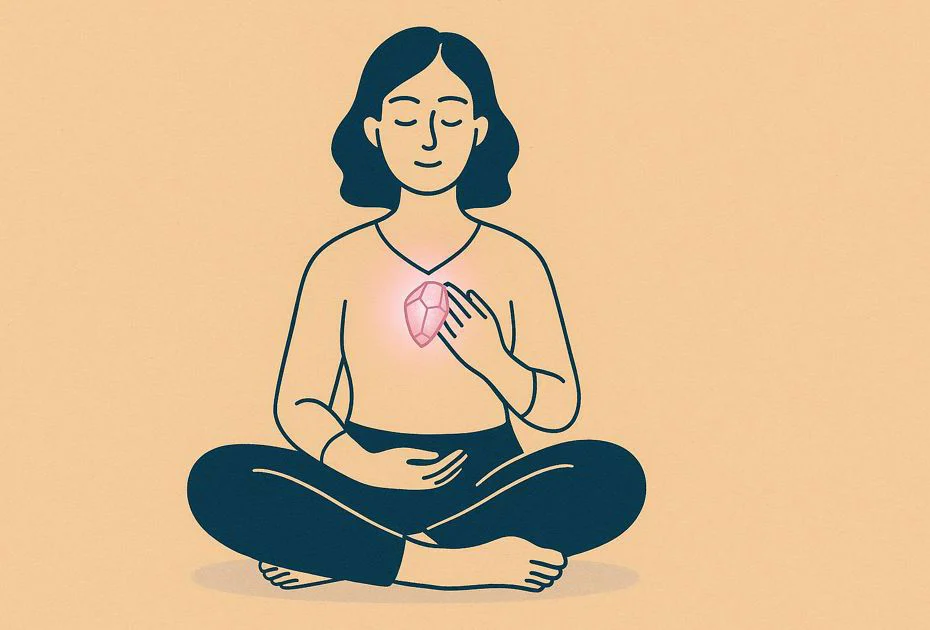
Rose quartz is traditionally associated with opening the heart, compassion, and emotional healing. Many people use it as an anchor for heart meditations and associate it with the desire for more self-love and inner warmth. Perhaps you have experienced yourself that just looking at or holding a rose quartz creates an atmosphere of security in which you can let go more easily. The stone not only appears in meditation rooms, but also accompanies many as a necklace, palm stone, or simply as a small companion on the nightstand.
The question repeatedly arises as to whether rose quartz actually has an effect or whether it is simply a loving custom. Scientific research cannot attribute any directly measurable effect to the stone itself—there are no studies that prove a specific change caused by rose quartz alone. Nevertheless, many people report noticeable changes in their well-being, in dealing with difficult emotions, or in their relationships with others when they consciously incorporate the stone into their practice. For many, rose quartz is more than just a beautiful accessory: it is a symbol of healing, gentleness, and a friendly view of oneself.
What is the crown chakra?
Do you know the feeling that despite morning meditation or short breathing exercise you are always i…
In practice, many people use rose quartz to cultivate more self-compassion and warmth of heart. It is particularly popular to wear the stone directly on the heart—as jewelry or as a small stone in a shirt pocket. Some place it on their chest during meditation, others simply hold it in their hand. Affirmations such as “I am loving towards myself” or “My heart is open to healing” are often used to accompany this practice. In these moments, rose quartz serves as a visible anchor: it reminds you to focus on your heart and treat yourself kindly. The energy that many associate with the stone makes meditation gentler and more loving for many people.
From a scientific perspective, there is another approach that fits well with this practice: loving-kindness or metta meditation. Studies show that even short sessions of this meditation can increase compassion, empathy, and general well-being. It’s not so much about the stone as it is about consciously focusing your attention. Using rose quartz as an anchor can enhance the effect of metta meditation because it gives you a clear focus and a ritual that keeps you in the moment.
A simple way to combine both is as follows: Sit comfortably, hold the rose quartz in your left hand close to your heart, and close your eyes. Breathe in and out calmly and deeply. Then repeat a short loving-kindness affirmation internally, for example: “May I be happy and healthy. May I be free from suffering. May I live in safety and peace.” As you say these words, consciously feel the weight and coolness of the stone and imagine a feeling of warmth and kindness spreading through your chest with each breath. Research shows that this type of meditation can increase emotional well-being and empathy in the short term—regardless of whether you use a stone or not. The rose quartz serves as a ritual anchor that gently brings you back to the here and now.
Many people report that after a few minutes of meditation with rose quartz, their heart feels lighter and more relaxed. Especially in difficult times—after disappointment, during periods of stress or uncertainty—this practice can help you treat yourself with more patience and forbearance. An example from everyday life: After a long, exhausting day, you sit down, place the rose quartz on your chest, and take a deep breath. At first, you may find it difficult to relax or develop kind thoughts towards yourself. With each breath, however, you feel the tension in your chest release and a feeling of softness arise. After a few days of this little routine, many report that they are calmer, more relaxed, and less self-critical.
It is important to understand the role of intention and the placebo effect in this context. Research shows that simply believing in the effectiveness of an action—such as consciously holding a stone—can trigger positive changes in the body and brain. This applies to medication, rituals, and even meditation with a physical anchor such as rose quartz. By giving the stone personal meaning and using it as a symbol of compassion, you activate networks in the brain that promote well-being, security, and calm.
The combination of mindfulness, breathing exercises, and body awareness also makes practicing with rose quartz particularly valuable for many people. As you focus on your heart and use the stone as an anchor, you concentrate your attention and create a safe space where you can treat yourself with kindness. This is especially helpful if you want to detach yourself from external expectations or inner turmoil.
An everyday exercise with rose quartz could look like this: Find a quiet place and sit down comfortably. Take the stone in your left hand, hold it to your heart, and close your eyes. Breathe calmly and deeply, feel the weight of the stone, and concentrate on the sensations in your chest. When thoughts or feelings arise, imagine that the stone absorbs the tension and transforms it into gentle, loving energy. While doing so, repeat a simple affirmation, for example: “I am enough just as I am.” Just a few minutes are enough to relax the heart and start the day with more ease.
There are also a few practical tips for handling rose quartz: The stone is generally robust, but can be damaged by aggressive cleaning—for example, with harsh cleaning agents or very hot water. It is sufficient to clean it under lukewarm water and occasionally “discharge” it in the fresh air or on a windowsill. This will keep the stone beautiful and ready for use for a long time.
Whether rose quartz has a measurable effect or not, what matters is your personal experience. Regular practice with a lovingly designed ritual can make a real difference, especially in times of stress or emotional uncertainty. Many people report that the combination of mindfulness, breathing exercises, and a small anchor such as rose quartz makes it easier for them to access their feelings and develop more self-compassion.
The beauty of this practice is that it can be flexibly incorporated into everyday life without much effort or prior knowledge. You can hold the stone in your hand for a few minutes in the morning while you get ready for the day, or calm down in the evening by focusing on your heart. Even in difficult moments—such as after an argument or when you feel overwhelmed—rose quartz can help you calm yourself and get back in touch with your inner balance.
Many who meditate regularly with rose quartz report feeling more serene, open-hearted, and friendly toward themselves. The effect comes from the interplay of intention, mindfulness, and ritual—regardless of whether the stone itself has any objectively measurable power. It is important to allow yourself to start with small steps and adapt the practice to your needs.
You may have already noticed that certain stones resonate with you more than others. This is completely normal and part of the individual process. The important thing is to embrace what feels good for you and try out the practice with an open, friendly attitude.
For many, rose quartz has become a symbol of compassion, openness of heart, and loving self-care. The combination of traditional knowledge, modern mindfulness practices, and a soothing ritual creates a space where you can realign yourself again and again.
In the next section, we will look at another crystal that plays a special role in meditation for many people—especially when it comes to clarity, focus, and focusing energy.
Rock crystal: Amplifier and energy supplier
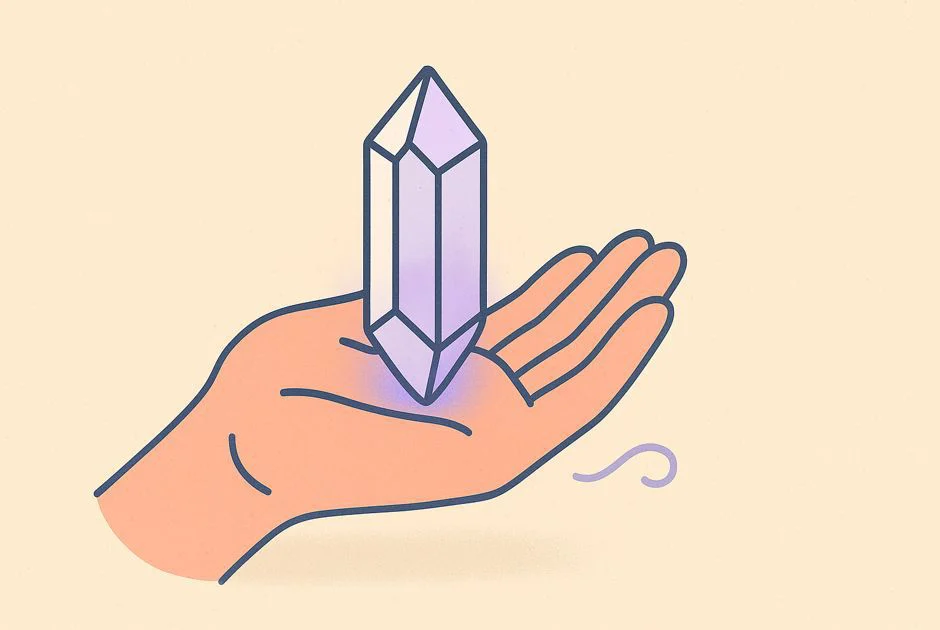
Rock crystal appears as a central element in many meditation practices. Traditionally, it is considered an “amplifier” – it is said to intensify the effects of other stones and to provide clarity and energy itself. Many report that when meditating with rock crystal, they feel they can see more clearly, are more focused, or even feel more energetic. The idea that a rock crystal can bundle or amplify the energy of other crystals when placed near them is particularly widespread. This idea is especially well known in spiritual and energetic traditions. However, it is important to emphasize that there is no solid empirical research proving crystal physical amplification in the sense of measurable energy transfer; the effect is based on ritual, focus, and intention.
When you start working with rock crystal, you will quickly notice that symbolism plays a major role. While stones such as amethyst or rose quartz often represent specific themes such as calmness or opening the heart, rock crystal stands for clarity for many people – both on a mental and energetic level. In practice, it is often used as the centerpiece in so-called crystal grids. This involves placing several stones in a specific pattern around a central rock crystal. This “grid” not only looks beautiful, but is also said to bundle the energy in the room and align it in a targeted manner. Many people begin their meditation by placing the rock crystal in the center and imagining a field of clarity and light emanating from it.
Meditation cushion
-
Anahata Harmony
49,95 € -
Manipura Strength
49,95 € -
Muladhara Balance
49,95 € -
Sahasrara Connect
49,95 €
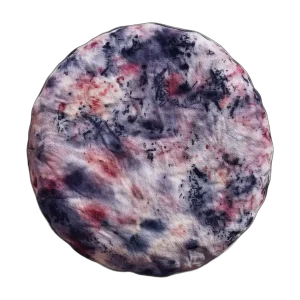
Rock crystal is also traditionally used for cleansing—for rooms, other stones, or your own energy field. The idea behind this is that, thanks to its neutral, transparent structure, rock crystal neutralizes foreign energies and supports transformation. Many people place it on windowsills to refract light, use it as a palm stone, or place it directly on their meditation cushion. Many people turn to this stone when they are longing for more focus or clarity.
Perhaps you know the feeling: you want to meditate, but your thoughts keep jumping back and forth. In moments like these, it can help to hold a clear rock crystal in your hand. Feel its coolness, its weight, its smooth surface. After a few conscious breaths, everyday life recedes into the background and you find it easier to access your inner focus. For many, holding the stone is a starting signal: now the practice begins, now only the moment counts.
There is no scientific evidence that rock crystal produces a noticeable amplification in the physical sense. However, research shows how effective rituals and conscious anchors are for focusing attention. Whether you observe your breath, feel the weight of the stone, or watch the play of light in the crystal, you are always bringing your mind into the here and now. This is precisely where its value lies: rock crystal serves as a symbol and anchor that helps you collect yourself and find clarity.
The real power lies in the conscious connection between stone, intention, and attention. If you decide to use rock crystal as an anchor for clarity today, your meditation will take on a new depth. The setting changes: you are more present, your focus becomes clearer, and you can more easily detach yourself from distracting thoughts. Especially for beginners who struggle with inner restlessness, rock crystal offers an easy way to focus their attention.
So that you can try out the effect for yourself, here is a short and structured rock crystal focus session that you can incorporate into your day at any time:
Sit comfortably and ensure you have a few minutes of undisturbed time. Take a transparent rock crystal in your hand, preferably your non-dominant hand, so that you can perceive it clearly. Close your eyes and take five conscious, deep breaths. Feel the coolness and solidity of the stone in your hand. With each inhalation, imagine a clear beam of light flowing through the crystal into your body—from the stone, through your hand, into your chest. As you exhale, let go of everything that is weighing you down or distracting you. Stay with this visualization for two to four minutes, returning to the feeling of the stone and your breath whenever your thoughts wander. Finally, slowly open your eyes and notice whether your clarity or presence has changed.
Many report that even this short exercise helps to clear their minds and focus on what is important. The rock crystal thus becomes a tool that you can use flexibly—before important conversations, before going to bed, or whenever you feel like you are losing yourself. It is not important whether you believe in an actual transfer of energy. Much more important is the experience that you can control your attention with a small ritual and a clear intention.
If you tend to get distracted easily in everyday life or get lost in repetitive thoughts, rock crystal can be a helpful companion. Many people use it as an integral part of their morning routine or keep it handy on their desk to remind themselves of their own focus. Over time, this becomes a positive habit: the stone signals to you that a moment of clarity and reflection is beginning.
Another aspect that is repeatedly emphasized in practice with rock crystal is the connection between visualization and body awareness. The more consciously you shape the interplay of breath, anchor, and intention, the deeper the meditation can work. Advanced practitioners often combine rock crystal practice with targeted visualizations: they imagine light being concentrated through the stone and distributed throughout the body or room. These images help to calm the mind and create a state of inner expansiveness.
Even though the effect of rock crystal cannot be measured, many personal testimonials show that the ritual itself makes a difference. It is the conscious time you take for yourself, focusing on the moment and clearly setting an intention, that makes the practice valuable. This applies not only to meditation, but also to many everyday situations—for example, when you need to gather your thoughts before a new task or want to find yourself again after a long day.
Some people place their rock crystal in a fixed location after meditation, for example on the windowsill or in their meditation cushion, to “recharge” it or simply to have a visible reminder of their practice. Others take it with them as a small anchor to quickly regain their composure in stressful situations. It is important that you find out for yourself how the stone best supports you and which ritual feels right for you.
Practicing with rock crystal is simple, flexible, and easy to integrate into your everyday life—regardless of whether you consider yourself a beginner or an advanced practitioner. The key is to give yourself permission to experiment and find out what really works for you. Over time, you will notice how small rituals and conscious anchors deepen your meditation and help you to be clearer and more present outside of your sessions.
There are many ways you can support your meditation space or energy field. While rock crystal is primarily associated with clarity and focus, there are other stones that are specifically used for cleansing, protection, and deeper insight. Each stone has its own unique qualities that you can incorporate into your practice. In the next section, we will look at how you can use selenite and lapis lazuli to create new approaches to energy hygiene and inner wisdom.
Selenite and lapis lazuli: Pure energy and deep insight
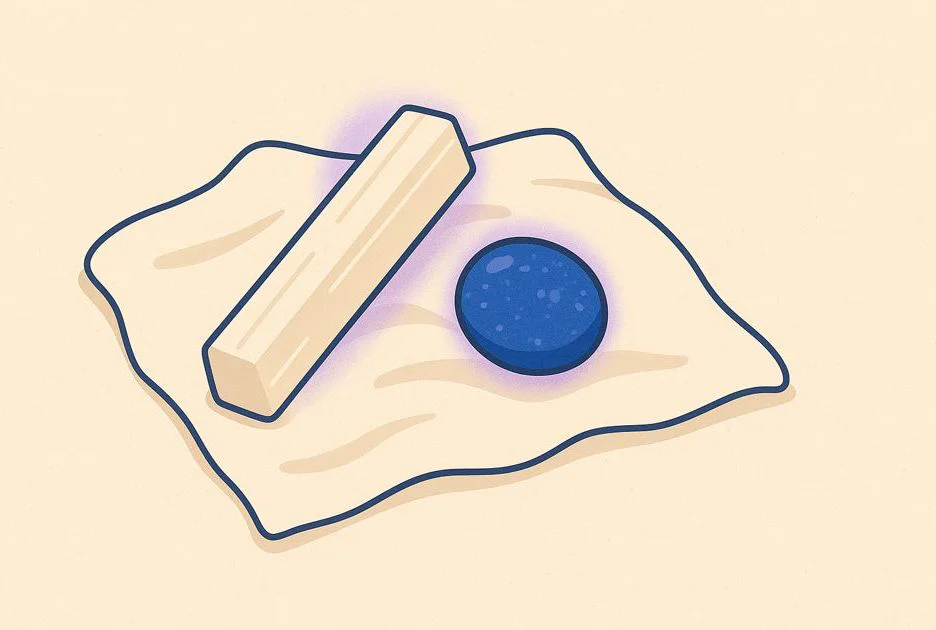
Many people who start meditating are looking for ways to promote clarity and inner peace. Two stones that are often mentioned in this context are selenite and lapis lazuli. They are often considered opposites: selenite stands for light-filled purification and energetic freshness, while lapis lazuli stands for deep insight and conscious awareness of one’s own thoughts. Both have their place in practice when it comes to clearing one’s own energy field or creating access to inner wisdom—each in its own way.
Selenite immediately catches the eye with its light, almost translucent structure. Many refer to it as a “light bringer” and use it to cleanse rooms, stones, or their own energy field. However, it is important to note that selenite is sensitive to water and should never be placed in water, as it can dissolve or become damaged. Selenite is particularly well suited for cleansing other stones – simply place the desired stone on a selenite rod or in a selenite bowl for a few hours. This allows you to achieve energetic cleansing without water while protecting the sensitive surface.
Meditate better – sit differently
Meditation does not begin in the mind, but in the body. Studies show that an upright spine creates a…
In everyday life, many people report that after a long day or intense conversations, they feel the need to free themselves from external influences. Selenite is often used for this purpose by gently holding it over the body—for example, on the shoulders, along the arms, or in the area of the heart. The idea behind this is that selenite does not absorb energy, but rather conducts it and helps to release old tensions and restlessness. It is particularly popular to sweep the room with a selenite wand before meditation to create a clear, calm atmosphere. The movement is slow and deliberate, almost like a small circle of light that removes all heaviness from the room.
Lapis lazuli, on the other hand, is traditionally associated with intuition, inner truth, and the so-called “third eye”—the area between the eyebrows, which in many teachings represents insight and mental clarity. Many people report that meditating with lapis lazuli gives them better access to their thoughts and inner voice. These effects are subjective and based on individual experiences, but they are plausibly supported by meditative practice and targeted attention training. When you place lapis lazuli on your forehead or hold it in your hand, you focus your concentration specifically on this area. This can help to clear the fog of thoughts and gain a clearer view of your own beliefs and patterns.
In our hectic everyday lives, we often lose our balance. Sometimes we absorb moods, worries, or stress from outside sources without even realizing it. This can feel like a veil covering our own mind. This is exactly where selenite and lapis lazuli come in. They offer you two different paths: selenite as a tool for energetic cleansing and lapis lazuli as an anchor for deep insight and conscious self-reflection.
A practical technique that combines both stones is a short 3-step routine that you can use both at the beginning and end of your meditation. Step one: Slowly and mindfully run a selenite wand over the edges of your meditation space or hold it loosely in your hands for a few minutes. As you do so, visualize bright light emanating from the selenite and removing everything that is worn out and burdensome from your field. Step two: Place a lapis lazuli on your forehead or hold it in your hand. Feel its coolness and weight, and concentrate on the sensation at this point. Step three: Focus on your breath for about three minutes. With each inhalation, imagine clarity and light flowing into you. With each exhalation, let go of everything that blocks you internally. Imagine a clear opening emerging—as if you were pushing aside an inner curtain and creating more space for new insights.
This routine is simple and suitable for everyday use. It combines the ritual of energetic cleansing with targeted training of attention and self-awareness. From a scientific perspective, consciously directing attention to a sensory stimulus—such as the weight or temperature of a stone—promotes the ability to reduce internal distractions. This can be particularly helpful for people who tend to brood or are easily distracted. Visualizing light, clarity, and openness enhances the effect because it aligns the brain with a positive state.
Many report feeling lighter, clearer, and calmer after this short practice. Selenite helps to get rid of the feeling of “foreign energies” or emotional baggage, while lapis lazuli creates access to deeper knowledge and greater self-confidence. Conscious holding, feeling, and visualizing make the difference—not the stone alone, but the interplay of intention, mindfulness, and ritual.
Another advantage of this method is its flexibility. You can use it in the morning to start the day feeling fresh and clear-headed, or in the evening to reconnect with yourself after a stressful day. This short routine can also help you refocus in between—for example, after a difficult conversation or in moments when you feel mentally blocked. It is important that you give yourself time and use the technique regularly. The more often you integrate it into your everyday life, the easier it will be to notice its effects and benefit from them.
In addition to cleansing stones or rooms, selenite is also suitable as a gentle companion during meditation itself. You can place it on your meditation cushion, hold it in your hand, or simply place it in the room to create a clear, open atmosphere. Lapis lazuli, on the other hand, is particularly helpful when you feel stuck on a question or decision. Many people use it to develop more courage to be honest with themselves and to strengthen their intuition.
When handling selenite, always follow the care instructions: Selenite is sensitive to water and should never be placed in water. Instead, use dry cleaning methods, such as dusting with a soft cloth or placing it on a dry surface. To energetically cleanse other stones, simply place them on a selenite rod or in a selenite bowl for a few hours. This will keep the selenite beautiful and effective for a long time.
If you work regularly with selenite and lapis lazuli, you will notice that your own practice changes. Many people report that after a few weeks, they become more aware of their thoughts and feelings and notice more quickly when they lose their balance. The combination of cleansing and insight helps you to find your center again and again and not let yourself be overwhelmed by external influences.
The practice with selenite and lapis lazuli is suitable for beginners as well as advanced practitioners. It is straightforward, flexible, and can be easily adapted to various everyday situations. The key is to allow yourself to start with small steps and explore the effects at your own pace. Over time, this will create a stable routine that will help you stay grounded and see clearly, even in turbulent times.
Some people supplement the practice with affirmations or short mantras to deepen the effect. Phrases such as “I am open to clarity” or “I let go of the old and open myself to new insights” can reinforce the intention and help to maintain focus. Conscious breathing and feeling your own body are also central elements that round off meditation with these stones.
Especially when you long for a fresh start or feel overwhelmed by impressions and thoughts, selenite and lapis lazuli offer a simple way to restore order and lightness. The combination of cleansing, insight, and focused attention makes this practice particularly effective—not as a magic potion, but as a tool that you can actively use for yourself.
In everyday life, we repeatedly encounter situations in which we not only want to clarify things, but also protect and ground ourselves. Especially in stressful moments or when external influences take over, the desire for stability and security becomes great. In the next part, you will learn how to specifically incorporate grounding and protection into your practice and which stones can support you in doing so.
Black tourmaline and tiger’s eye: Grounding and protection in everyday life
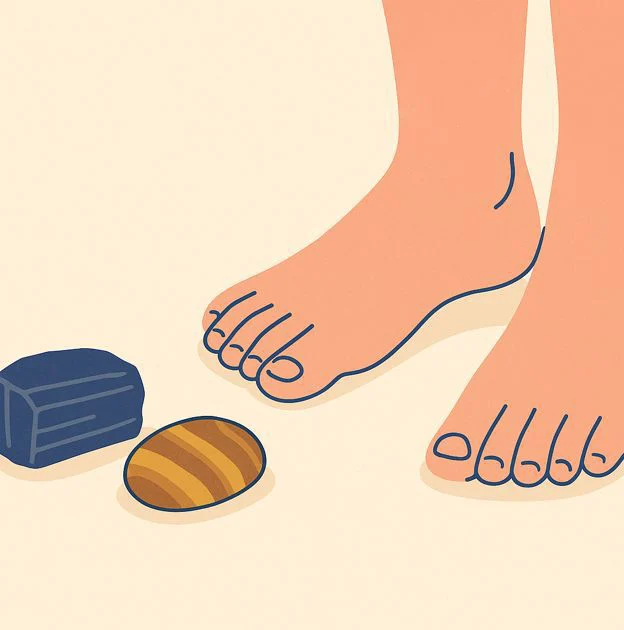
In everyday life, there are many moments when we long for more stability and protection. Especially when we are bombarded with appointments, news, and constant noise, our heads quickly feel full, our hearts become restless, and we lose touch with our own bodies. In such situations, many people look for an anchor to bring them back to the here and now. This is where black tourmaline and tiger’s eye come into play, as both stones are traditionally associated with grounding and protection.
Black tourmaline has long been used as a protective stone in many cultures. It is said to ward off negative influences and create a safe space when the outside world becomes too loud. Tiger’s eye, on the other hand, stands for grounding, courage, and stability. Its golden brown stripes are reminiscent of strength and warmth—qualities that are especially sought after when you feel weak, disoriented, or restless inside. Important to know: The attributions to protection and grounding are based on tradition and subjective experiences. There is no scientific evidence that crystals such as black tourmaline protect against electromagnetic fields. However, many people experience psychological security and better grounding through the ritualized holding of a protective stone. It is above all the conscious perception, the weight in the hand, and the associated intention that have a noticeable effect for many.
Perhaps you know the feeling of being unable to switch off after a long day. Your to-do list isn’t getting any shorter, new emails are coming in, and in between, you feel guilty because you’ve missed another break. In moments like these, it helps to set a specific grounding anchor. Studies show that meditation and mindfulness exercises have been proven to lower cortisol levels and reduce stress reactions in the body. Consciously incorporating a stone such as black tourmaline can transfer these calming effects into everyday life as a ritualized anchor. The stone becomes a visible signal: now is the time to take a deep breath and refocus.
To help you achieve this even in your hectic everyday life, I would like to introduce you to a simple micro-exercise that you can try out right away. It only takes 60 to 90 seconds and is particularly suitable if you want to quickly regain your composure:
- Sit upright with your feet firmly on the floor.
- Take a black tourmaline in your dominant hand.
- Close your eyes and take six deep breaths in through your nose and slowly out through your mouth.
- As you breathe, imagine a powerful earth ray growing deep into the ground from your feet. With each inhalation, power flows from the earth into your body; with each exhalation, you release tension—as if the tourmaline were absorbing everything that weighs you down.
You can do this exercise whenever you feel stressed, restless, or overwhelmed. Many people report feeling calmer, clearer, and more stable after just a few breaths. The stone in your hand reminds you that you have a firm footing—even when everything around you is in motion.
The tiger’s eye complements this practice particularly well if you are seeking greater confidence and inner strength. It is traditionally valued as a stone for courage and self-confidence. Many people wear it as a pendant, hold it in their hand during meditation, or place it on their solar plexus. Here, too, the focus is not on the objective effect of the stone, but on the ritual: you take a moment to feel its smooth surface and consciously connect with your own power. The tiger’s eye can help you to re-center yourself and perceive your own point of view more clearly.
Here is a small exercise you can try with the tiger’s eye: Sit comfortably, hold the tiger’s eye in your hand or place it on your solar plexus. Breathe in and out calmly. With each breath, imagine courage, energy, and confidence flowing into your body. If you like, you can say to yourself: “I stand firm in life. I am strong and secure.” Stay with this visualization for two to three minutes and observe how your body feels.
It is interesting to observe how differently people react to these rituals. Some feel a change immediately, while others need a little practice to notice the effect. The key is to make time for these little islands of calm on a regular basis. The more often you repeat the exercise, the easier it will be to ground and protect yourself, even in difficult situations. Over time, you will develop a routine that will make you more resilient and help you recognize when you need a break more quickly.
You can use black tourmaline and tiger’s eye flexibly in everyday life. Many people place their stones on their desk, in their car, or on their bedside table to remind themselves of their practice. Even when you’re out and about—for example, on walks—a small stone in your pocket can be a good anchor to help you deepen your breathing and consciously feel your feet on the ground. It’s not about doing everything perfectly, but about creating small rituals that support you and give you security.
Another advantage of this practice is that you can customize it to suit your individual needs. You may find that black tourmaline helps you particularly in stressful situations, while tiger’s eye gives you courage for the day ahead in the morning. It is important to listen to your own feelings and find out which stone best suits you in which situation.
The beauty of these simple techniques is that they bring you back to the here and now again and again. You learn to pay better attention to your body’s signals and not let external demands overwhelm you. Over time, this creates a new form of stability that does not depend on external circumstances, but grows from within yourself.
Some people combine the practice with short affirmations or breathing techniques to enhance the effect. For example, you could take three deep breaths in the morning while holding the stone in your hand and say to yourself, “I am protected. I am grounded. I am ready for the day.” Small rituals like this help you start the day more consciously and face challenges with greater composure.
When you feel like everything is getting on top of you, it’s worth taking a moment to pause and stabilize yourself with a simple grounding exercise. The combination of meditation, breathing exercises, and a physical anchor such as black tourmaline or tiger’s eye makes it easier to reduce stress and regain focus. You don’t have to be an expert—just a few minutes are enough to feel the difference.
These tools will help you build a foundation that you can always fall back on. They will give you stability when things get turbulent on the outside and strengthen your confidence in your own strength. Step by step, this will bring more serenity into your everyday life.
However, there are also times when grounding and protection alone are not enough—for example, when you feel stuck or inner blockages are holding you back. This raises the question of how you can bring more ease and movement back into your life.
Ametrine and labradorite: Experience harmony and transformation

Ametrine and labradorite often become interesting when you want more balance and movement in stuck situations. Both stones are known in traditional crystal healing for their special qualities: Ametrine is seen as a combination of amethyst and citrine – calm and clarity on the one hand, energy and lightness on the other. Users report that ametrine helps them find inner balance more easily when their thoughts and feelings become entangled or everyday life becomes too much. Labradorite, on the other hand, is traditionally considered a stone of transformation and intuition. Many people describe how labradorite helps them develop new perspectives and gently let go of old patterns. It is important to emphasize that these attributions are based on anecdotal evidence and tradition – there is no scientific evidence for specific effects. Nevertheless, the subjective experiences of many users are often valuable in practice.
Perhaps you are familiar with this feeling: there are days when everything seems to stagnate. Your thoughts go round in circles, decisions are difficult to make, and it feels as if you have lost your inner balance. In moments like these, it can help to support your meditation practice with specific rituals. Ametrine is traditionally recommended as a stone for balance—especially if you feel torn between different poles. Its play of colors, ranging from violet to golden yellow, symbolizes the connection between relaxation and energy. Many people report that simply holding ametrine helps them to center themselves again and clear their minds without losing their vitality.
Why meditation is not a miracle cure – but still works
Be honest: have you ever noticed how quickly stress raises your pulse? That’s exactly where me…
Labradorite is often chosen when change is imminent or you want more courage to break new ground. Its shimmering colors are reminiscent of the play of light and shadow – an image of transformation and the discovery of hidden aspects. Users describe how, when meditating with labradorite, they sometimes feel a creative impulse or suddenly find access to new solutions. Here, too, the effect arises from the interplay of intention, attention, and the ritual itself—not from a measurable, objective power of the stone.
If these topics appeal to you, why not try a little exploration exercise with both stones? It is a good way to strengthen harmony and openness to change in everyday life. Find a quiet place where you will not be disturbed for five to eight minutes. Sit comfortably with both feet firmly on the floor. First, take the ametrine in your dominant hand. Close your eyes and take a few deep breaths in through your nose and out slowly through your mouth. Feel the weight and temperature of the stone in your hand. Imagine how with each breath a feeling of balance and calm flows into your body. Visualize the colors of the ametrine—violet and golden yellow—spreading throughout your chest and harmonizing everything that feels tense or confused. Stay with this perception for two to three minutes and consciously notice how your body and mind feel.
Now put the ametrine aside and take the labradorite in your other hand. Repeat the breathing exercises and focus your attention on an issue that you would like to change or clarify. It doesn’t have to be anything major – sometimes a vague feeling that “something needs to change here” is enough. Feel the smooth surface and cool weight of the stone. Imagine how the light of the labradorite quietly sets impulses for new perspectives within you. With each exhalation, you can imagine how old blockages or stuck thoughts dissolve and make room for fresh energy. Stay in this perception for three to five minutes. Let thoughts come and go without holding on to them. At the end, slowly open your eyes, move your hands and feet, and notice if anything has changed.
This exploratory exercise is not a magic trick, but rather an invitation to examine your current state and remain open to small impulses. It is not about achieving immediate results, but about giving yourself space for development. Many people report feeling more balanced, clearer, or simply more curious after such rituals. You may also notice that a particular issue feels easier to deal with in everyday life or that a decision no longer weighs so heavily on your mind.
The combination of meditation, conscious breathing, and a physical anchor such as ametrine or labradorite can help to loosen inner knots. It is important to keep your expectations realistic: transformation rarely happens in big leaps, but usually in small, almost imperceptible steps. Regular practice strengthens your ability to allow change and embrace new things. Consciously naming your intention—that is, what you want to achieve with the exercise—makes a big difference. Whether you are looking for balance, more openness, or simply a little more lightness: formulate what is important to you right now and bring this attitude into your practice.
A tip for your everyday life: Place the stones in a fixed location where you will see them regularly—for example, on your desk, next to your bed, or in your meditation corner. This will remind you to take little breaks for yourself and keep your practice alive. If you like, share in the comments which stone appealed to you most today – ametrine or labradorite? I’m interested to hear how you perceive the effect and whether you feel any differences between the two stones.
Research into mindfulness also shows that it is often not the individual tool that makes the difference, but rather its conscious, regular use and inner focus. Those who repeatedly take time for small rituals not only train their minds, but also their ability to actively shape change. The stones serve as symbols and anchors to direct one’s attention and support the process of transformation.
In everyday life, it can be helpful to incorporate such exploratory exercises into your morning or evening routine. Just a few minutes are enough to feel a difference. It is important that you allow yourself to start with small steps and adapt the practice flexibly to your needs. Sometimes harmony and ease only come after repeated practice—give yourself the time you need.
Ametrine and labradorite are not miracle cures, but they can help you to become more mindful in your practice and more open to change. The real power lies in staying attentive, continually realigning yourself, and being open to new perspectives. The clearer your intention and the more regularly you practice, the easier it will be to stay balanced, even in difficult times.
You may be wondering why some rituals work immediately, while others hardly make a difference. Why is it that the same meditation is sometimes experienced completely differently with or without a stone? These questions lead us to the next important topic: What is the difference between a mere routine and an experience that truly touches you?
Intention and practice: The key to noticeable impact
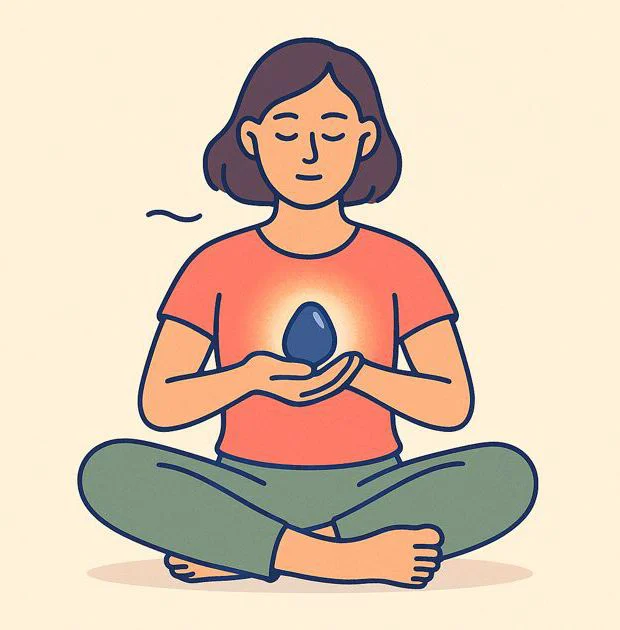
What really makes the difference when you meditate with crystals is not just the stone or the ritual, but above all your inner attitude and conscious focus—in other words, your intention. Many people report that they use crystals regularly but often feel little effect. They try different stones, follow recommendations from books or videos, and yet sometimes the special experience fails to materialize. This is rarely due to the choice of stone or meditation technique, but almost always to the question: With what inner clarity and intention do you approach your practice?
Intention means more than a vague desire. It is a conscious decision about how you want to shape your practice and what you hope to gain from it. Instead of simply meditating or placing a crystal next to you, you can make a specific plan for what you want to experience during this time. This could be inner peace, clarity, protection, love, grounding, or something else entirely. The clearer you formulate your intention, the stronger the effect can be. Your brain responds to this goal, focuses your attention differently, and anchors the experience more deeply. This applies to guided meditations as well as silent sessions with crystals.
Best-selling products
-
Muladhara Balance
49,95 € -
Swadhisthana Flow
49,95 € -
Manipura Strength
49,95 € -
Anahata Harmony
49,95 €
The importance of intention and expectation is also well documented scientifically. Studies show that the so-called placebo effect goes far beyond pure imagination. If you expect a certain effect and combine this expectation with a clear ritual, it can influence not only your perception but also physiological processes in the body. The brain releases different neurotransmitters, stress responses are dampened, and the immune system can be strengthened. So it is not the crystal itself that acts as a remedy, but the conscious combination of ritual, intention, and your own attention. These mechanisms highlight how important it is to actively shape your practice—not only on the level of external action, but above all through a clear inner focus.
To make your practice tangible, it helps to adapt it to your own needs and everyday situations. Many people start intuitively: they choose a stone that appeals to them or a theme that is currently relevant. Perhaps you need more courage today – then reach for the tiger’s eye. If you long for warmth in your heart, rose quartz might be the right choice. Cleaning the stone can be a small ritual in itself: hold it briefly under running water (only for waterproof stones), place it in selenite, or put it in the morning light. These simple gestures help you focus and consciously perceive the crystal as your companion—free from the impressions of the day.
An often underestimated step is the conscious activation of your crystal. Take a moment, hold the stone in front of your heart, and take three deep breaths in and out. While doing so, you can formulate a clear intention internally, for example: “Today, I choose this crystal as an anchor for clarity and serenity.” You can keep this activation simple or combine it with a little visualization, such as light flowing through the stone and absorbing your intention. The important thing is that you consciously shape this moment and feel how your attitude changes.
It is helpful to integrate crystals into your everyday life in a visible and tangible way. Wear your stone as jewelry, place it on your desk or in your coat pocket. Many people use small pocket stones as anchors – they remind them to pause for a moment and breathe consciously in the hustle and bustle of everyday life. In the bedroom, an amethyst can help you relax in the evening, while a rose quartz at work reminds you to be compassionate. This way, the practice becomes part of your day and not just a morning or evening ritual.
One tip that has proven particularly effective: start the day with a simple intention. In the morning, right after getting up, take a crystal in your left hand. Take three deep breaths in through your nose and slowly exhale. Then formulate your intention for the day in one sentence—for example, “I will remain calm today” or “I will take time for myself.” Carry the stone with you throughout the day. This mini practice takes less than a minute, but it is very effective because it reminds you of your focus and keeps the threshold for implementation low.
When choosing your crystals, also pay attention to their origin. More and more people value fair and sustainable sourcing. If possible, make sure that your stones come from ethically acceptable sources. This not only makes the practice more sustainable, but also more harmonious. It feels different when you know that your companion was obtained under fair conditions. This mindfulness in the use of resources reinforces the feeling of awareness and responsibility—an aspect that is particularly important to many who want to live mindfully.
Another example of the power of intention: Imagine sitting on your mat in the evening, holding a rock crystal in your hand and ready to leave the day behind. In the past, you may have simply hoped that meditation would calm you down. Now you take a moment, close your eyes and quietly say to yourself: “Today, I let go of everything that weighs me down. I open myself to clarity.” You feel your posture change—your breathing becomes calmer, your thoughts become clearer, and you are more present in the moment. After meditation, you notice that you feel lighter, even if not all your worries have disappeared. It is the conscious focus that makes the difference.
Over time, you will notice that combining intention, ritual, and crystal practice becomes easier and easier. The more often you incorporate small reminders into your everyday life, the more your attitude will be strengthened from within. The quality of your attention will change, and rituals will come alive—you will truly feel them instead of just performing them. Even for advanced practitioners, it is worthwhile to continually review and realign your own intention. Every day brings different issues, and sometimes a small adjustment is all it takes to make the practice feel fresh and meaningful again.
The effect of crystals in combination with intention and mindfulness is never rigid or clearly predictable. But as soon as you work consciously, space for genuine development arises. Whether you are just starting out or have been practicing for a long time, consciously designing each session becomes a source of strength. It is not how spectacular an experience is that counts, but whether it feels right for you and supports you in your everyday life.
Perhaps you feel like trying it out right away today. In the next part, I will show you how you can start your own crystal practice in a concrete and uncomplicated way—step by step, with simple techniques that you can implement immediately.
Your own crystal workshop: How to get started today
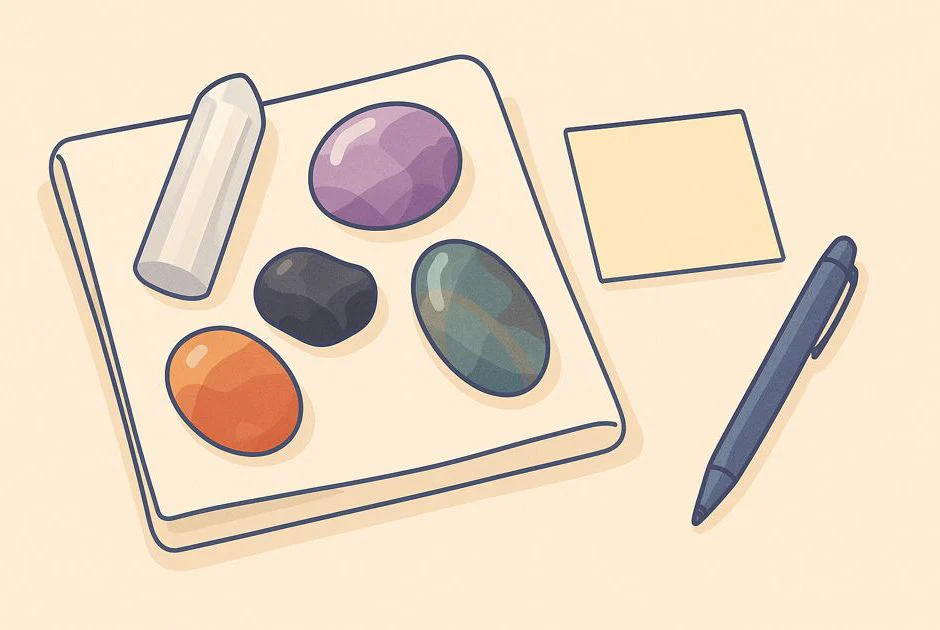
Many people wonder how they can start practicing with crystals in a practical way without overwhelming themselves or getting bogged down in too many details. Especially in the beginning, many questions arise: Which stone is right for me? How do I clean it properly? And how can I incorporate a small routine into my everyday life that remains truly feasible? It helps to clearly structure the first steps and not put yourself under pressure. To help you get started right away, I have put together a mini-workshop for you that will make it easier for you to get started.
Here is a simple, spoken checklist that you can use right away: First, choose one or two crystals that appeal to you spontaneously. Let your intuition guide you—often you can tell which stone is right for you today just by looking at it or touching it. Second, cleanse the stones before using them for the first time. Many people use a selenite wand or selenite plate for this: Simply place your crystal on it for a few hours to clear its energy. Alternatively, you can place it on the windowsill in the moonlight (preferably during a full moon) or smudge it with gentle smoke from mugwort or sage. Very important: Never put sensitive stones such as selenite, fluorite, calcite, or azurite in water – they could dissolve or be damaged. For these stones, cleansing with selenite, smoke, or moonlight is the safest method. Third, incorporate a short ritual of at least three minutes per day: hold the stone, breathe consciously, and set a clear intention. This makes it easy to get started and helps you develop a new habit.
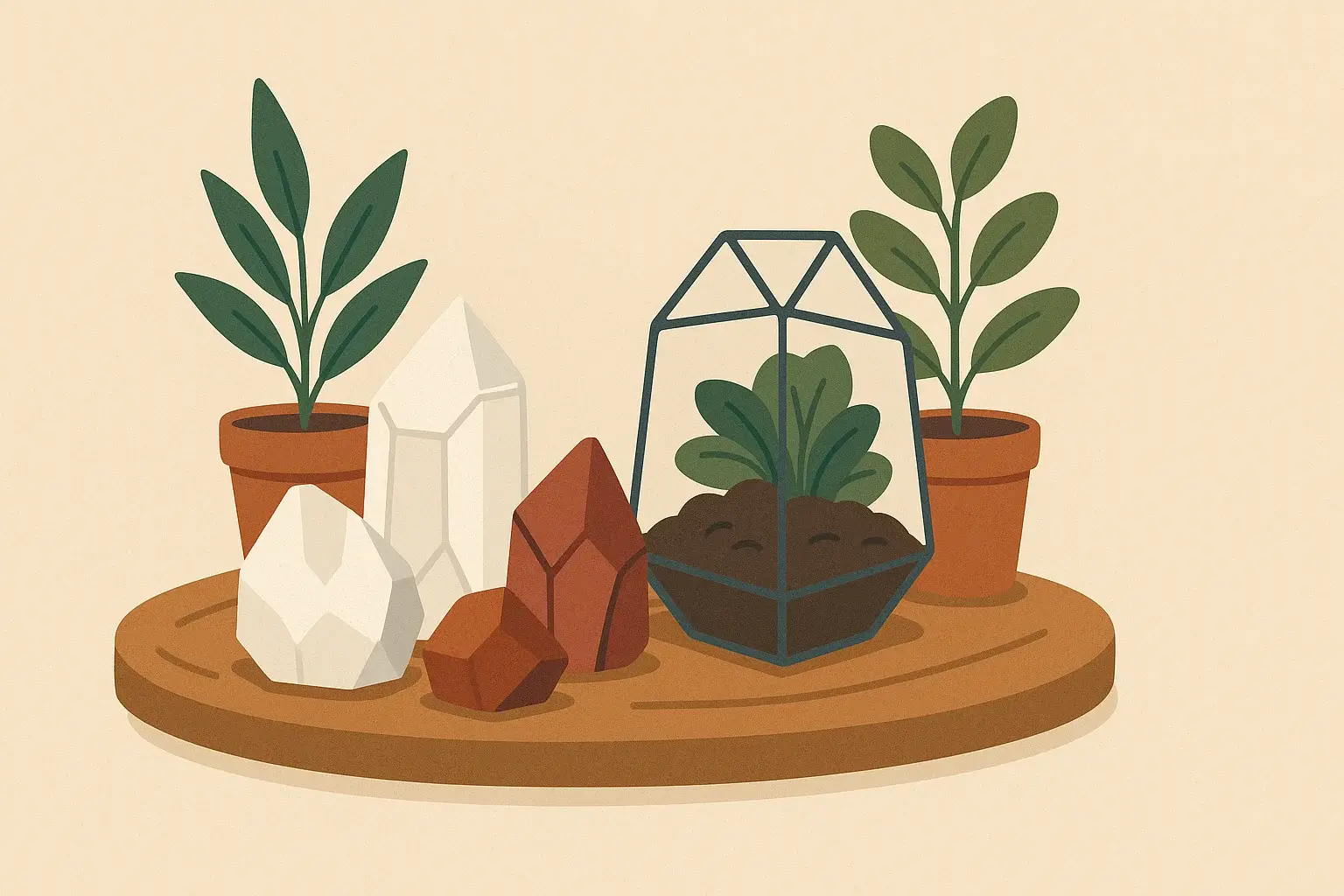
Creative combinations of crystals
Combining different stones can not only be aesthetically pleasing, but can also bring together diffe…
Choosing the right crystal is often less complicated than many people think. There are numerous meanings and associations, but the most important thing is your own intuition. Lay several stones out in front of you and choose the one that appeals to you most. For example, if you need more protection, try black tourmaline. If you long for lightness, ametrine may be a good choice. Rose quartz is suitable for opening your heart. Over time, you will notice which stones appeal to you most in certain phases of your life.
Once you have made your selection, the next step is to cleanse the stones. Many beginners are unsure how to do this. Here are the most important tips: Selenite is ideal for energetic cleansing – simply place the other stones on top of it without using water. Moonlight is also a gentle method that is suitable for all stones. When smudging, hold the stone briefly over the smoke and imagine how old energies are being released. Water is only suitable for robust stones such as rock crystal, amethyst, or rose quartz. Avoid water at all costs with selenite, fluorite, calcite, azurite, and other water-soluble minerals to prevent damage. These tips will help you keep your stones beautiful and energetically clear for a long time.
Once you have cleansed your crystal, you can incorporate it directly into your practice. Sit comfortably with both feet firmly on the ground. Hold the stone in one or both hands. Close your eyes and take three deep breaths in through your nose and slowly out through your mouth. Feel the weight, temperature, and surface of the stone. Then formulate a clear intention for your practice—for example, “I want more peace today” or “I open my heart to compassion.” Say this sentence quietly or think it consciously. As you continue to breathe, keep bringing your attention back to the stone. When thoughts arise, gently bring your focus back to the feeling of the stone in your hand.
To start with, it is sufficient to do this exercise for three to five minutes. The point is not to feel something special right away, but to be mindful in the moment. The more often you repeat the ritual, the more familiar it becomes. Many people report that after just a few days, they notice a change in their perception—more calmness, more presence, or simply a pleasant feeling of arrival.
Once you feel more confident, you can combine different stones. For example, start with a grounding exercise by holding black tourmaline in your hand and focusing on your breath and your connection to the ground. After a few minutes, switch to rose quartz, which you hold to your heart to feel more warmth and compassion. You can also lay out small crystal grids by placing several stones in a circle around your meditation cushion. This creates a special atmosphere and helps you stay focused.
For advanced practitioners, it is worth experimenting with affirmations, visualizations, or breathing techniques. For example, during meditation, you can consciously visualize light flowing through the crystal or repeat a phrase such as “I am calm and clear.” Incorporating music, incense, or certain postures can also deepen your practice. The important thing is to remain open and find out what works best for you.
An additional tip for tracking your progress: Start a small seven-day mini journal. Every day after your practice, write down in two sentences which stone you worked with and how you feel afterwards. This will help you recognize patterns and become more aware of which rituals are good for you. The journal is completely voluntary, but many find it helpful for staying on track and recording small changes.
Your crystal practice doesn’t have to be complicated or time-consuming. Just a few minutes a day is enough to create a new connection to yourself and your everyday life. You can use the stones flexibly—in the morning as part of your morning routine, on the go as a pocket stone, or in the evening for relaxation. Many people place their stones on their desk, in their car, or next to their bed to remind themselves of their intention.
Caring for your stones is also part of mindfulness. Clean them regularly, make sure you use the right method, and treat them to a break in the moonlight or on a selenite plate every now and then. When you get new stones, find out whether they are waterproof or require special care. This not only preserves their beauty, but also strengthens your connection to your practice.
Your own crystal practice will evolve over time. You will find that your preferences and needs change. Sometimes a stone will suddenly no longer appeal to you, while another will come to the fore. This is normal and part of the process. Allow yourself to remain flexible and adapt your practice again and again. There is no right or wrong—the important thing is that you feel comfortable and that the exercises fit into your everyday life.
Top-rated products
-
Sahasrara Connect
49,95 € -
Muladhara Balance
49,95 € -
Swadhisthana Flow
49,95 € -
Manipura Strength
49,95 €
If you like, share your experiences with others—for example, in the comments or with friends who are also interested in meditation and crystals. Sharing can be inspiring and provide new ideas. You may also discover new stones or techniques that you haven’t encountered before.
Ultimately, what matters is that you find a practice that truly supports you. Small rituals, mindful moments, and connecting with your stone will help you become more present and calm in your everyday life. There is no need for perfection or long sessions—just three minutes a day can make a difference. Over time, your confidence in your own perception will grow, and the practice will become a solid anchor that you can always fall back on.
If you get involved and develop your own routine step by step, you will experience how meditation and crystals can work together. The experience is always individual—and that is exactly what makes it so valuable.
In the next part, we will look at how to bridge the gap between scientific findings, ancient traditions, and your own personal experience.
Conclusion: Bridging the gap between science, tradition, and personal experience
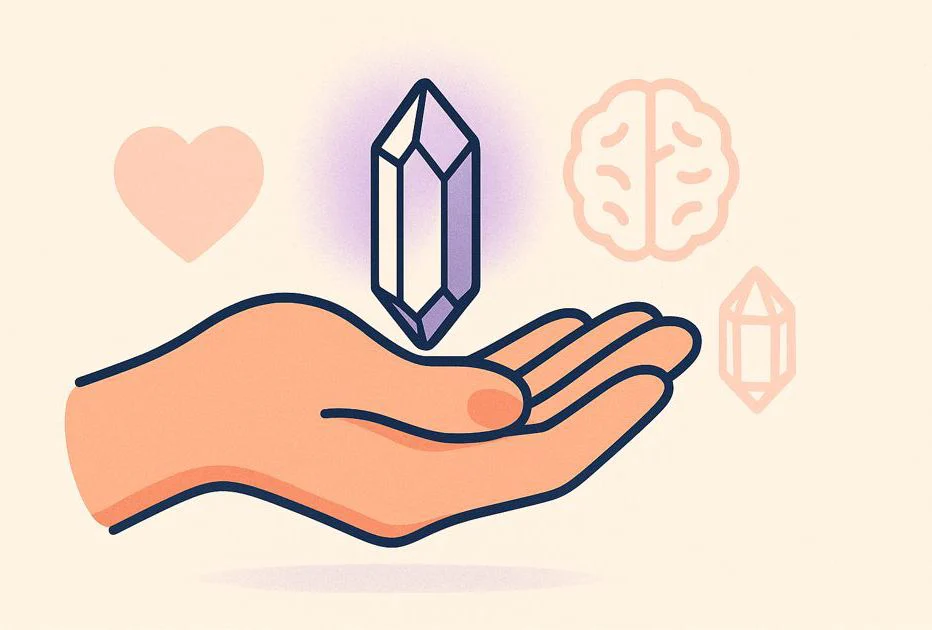
Meditation has been scientifically proven to be effective—it improves focus, serenity, and well-being. Crystals offer you meaningful support as ritualized anchors: they help to anchor intention and mindfulness in everyday life, but above all they work through your inner alignment and conscious ritual. The effects are not based on measurable energy transfer, but on intention, attention, and placebo mechanisms.
What is the sacral chakra?
Many people think that chakras are pure fantasy or esotericism. However, studies now show that medit…
Try out the short tourmaline grounding exercise we went through together and feel free to write in the comments how it felt for you. Crystal work is not a substitute for medical or psychotherapeutic treatment—it complements your personal practice.
Frequently asked questions about meditation with crystals
How can I effectively combine crystals with meditation?
Crystals such as amethyst or black tourmaline can be used as anchors in your meditation. Hold the stone consciously in your hand, formulate a clear intention, and focus your attention on it. This will noticeably enhance the effect of your mindfulness exercise.
Which crystal helps me best with stress?
Black tourmaline and amethyst are perfect for stress management. Tourmaline provides grounding and protection from negative influences, while amethyst promotes mental clarity and relaxation.
How do I clean and charge my meditation crystals correctly?
Use selenite plates, smoke, or moonlight to energetically cleanse your crystals. Never place selenite in water; robust stones such as amethyst or rose quartz can be rinsed under lukewarm water.
Do crystals have a proven effect on mindfulness?
The effects of meditation have been scientifically proven, but not those of crystals themselves. However, crystals can serve as ritual anchors to reinforce mindfulness and intention.
Which crystals are best suited for beginners?
Amethyst, rose quartz, and rock crystal are ideal stones for beginners. They promote clarity, openness of heart, and focus, and are easy to care for and handle.
This is how meditation becomes a habit
The real moment when motivation arises Do you know that great feeling you get right after exercising…

5 reasons why your meditation is failing
Why do so many people give up their meditation practice after just a few weeks—even though they know…
Crystals in meditation practice
Many people say that meditation with crystals is just esotericism—but recent studies on mindfulness …
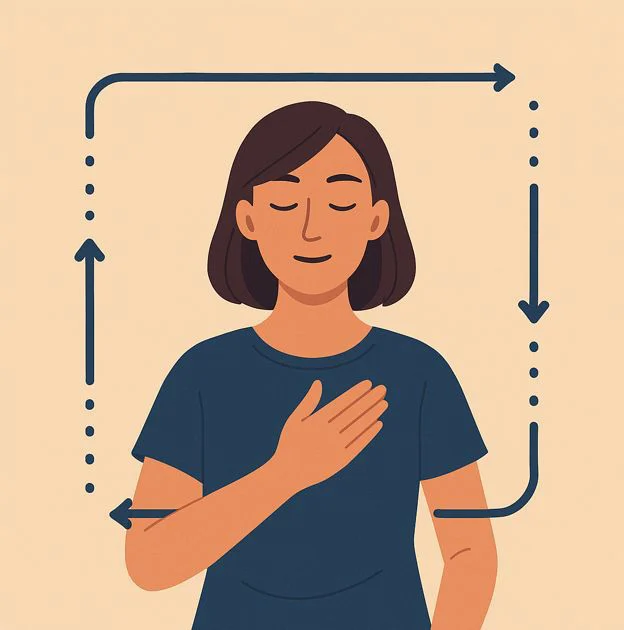
Box breathing stops stress immediately
Most people breathe incorrectly—and that is one of the main reasons why meditation is often difficul…

