

Do you really want to make a change, but everything always sounds so complicated? In fact, neuroscientific studies show that just a few minutes of meditation in the morning can have measurable effects on your stress levels and concentration. For example, one study showed that even a short six-minute body scan can significantly reduce stress levels in patients with chronic pain. Even in healthy people, a short, conscious breathing exercise has been shown to make the mind more alert and reduce irritability. One reason for this is that meditation has a direct effect on the nervous system – it can reduce the activity of the amygdala and increase GABA levels.
The good news is that you don’t need any complicated technology or a lot of time to do this. Five minutes in the morning is often enough to experience a noticeable difference. But why is this moment after waking up so crucial for your day?
Table of contents
The underrated moment: Why the morning is your best opportunity
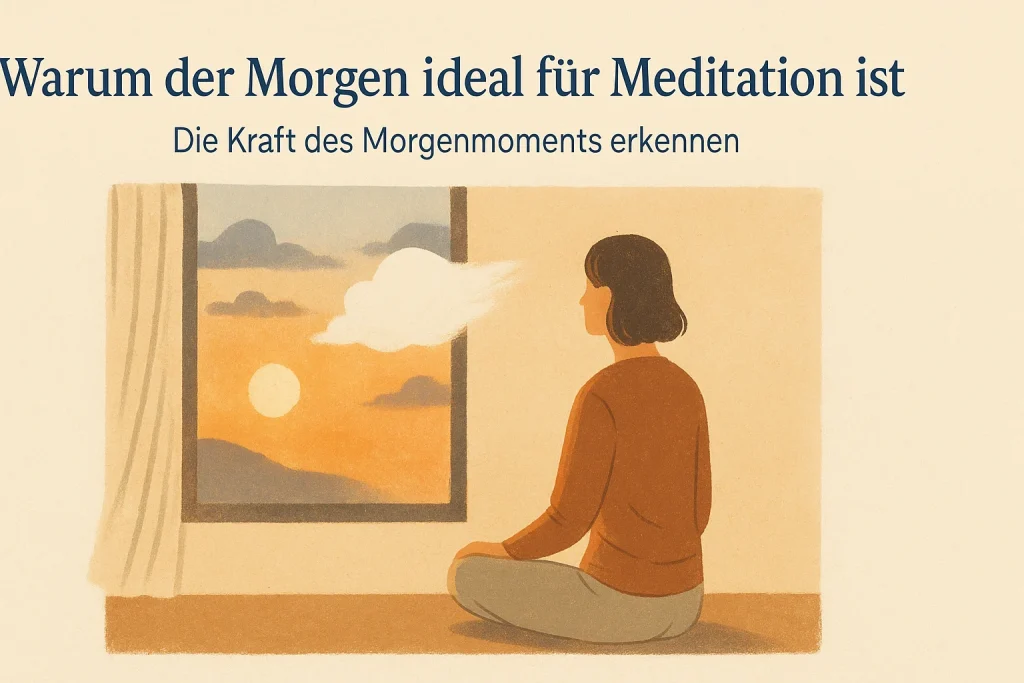
Many people underestimate how crucial the first few minutes after waking up are for the course of the entire day. While you are slowly waking up, your internal system is already working at full speed: your circadian rhythm, or internal clock, is now setting the pace, and your body is undergoing a natural rise in cortisol. This morning cortisol surge is not a sign of stress, but a signal to your body to wake up and become alert. Research shows that your attention and cognitive performance are particularly high during this phase – the brain is more receptive to new stimuli and routines. Studies such as those by Hung et al. prove that the efficiency of attention networks is particularly pronounced in the morning, which makes it easier to learn and consolidate new habits.
Meditation cushion
-

Anahata Harmony
49,95 € -
Manipura Strength
49,95 € -
Muladhara Balance
49,95 € -
Sahasrara Connect
49,95 €




Instead of starting the day in autopilot mode, you can make targeted use of this time slot. Researchers who study circadian rhythms emphasise that the morning is the best time to establish new routines. The brain is still unburdened by the impressions of the day, the filter mechanisms are less active – you are more receptive to positive changes. If you incorporate a little mindful practice now, you will lay the foundation for more serenity and focus throughout the rest of the day.
Practical examples from research demonstrate how effective these morning minutes can be. In a controlled study (Ramsburg & Youmans, 2013), students who meditated for just a few minutes before class remembered around 20% more learning content than their fellow students who did not practise meditation. This shows how even a short break in the morning can increase not only well-being but also mental performance. Such effects are not limited to students – many people report that a short breathing exercise after getting up helps them start the day with more calm and clarity and makes them less easily upset in stressful situations.
From a biological perspective, the moment after waking up is like a reset: your daily consciousness slowly kicks in, while old patterns and automatic reactions are not yet fully activated. The subconscious is particularly open to new impulses. If you breathe consciously and concentrate on your body for a few minutes, you set a clear starting point that can act as a protective shield against the stress of everyday life later on. Your internal clock gives you this window of opportunity – and it’s up to you to make the most of it.
Precisely because many routines arise in the morning, it is worth starting with a simple technique. It is not about establishing a perfect meditation practice straight away or sitting still for hours on end. Just five minutes of conscious breathing can make a noticeable difference – not only for your mind, but also for your nervous system. But how can you get started without it feeling like another chore or additional stress?
Your introduction: The 5-minute breathing exercise that will change your day
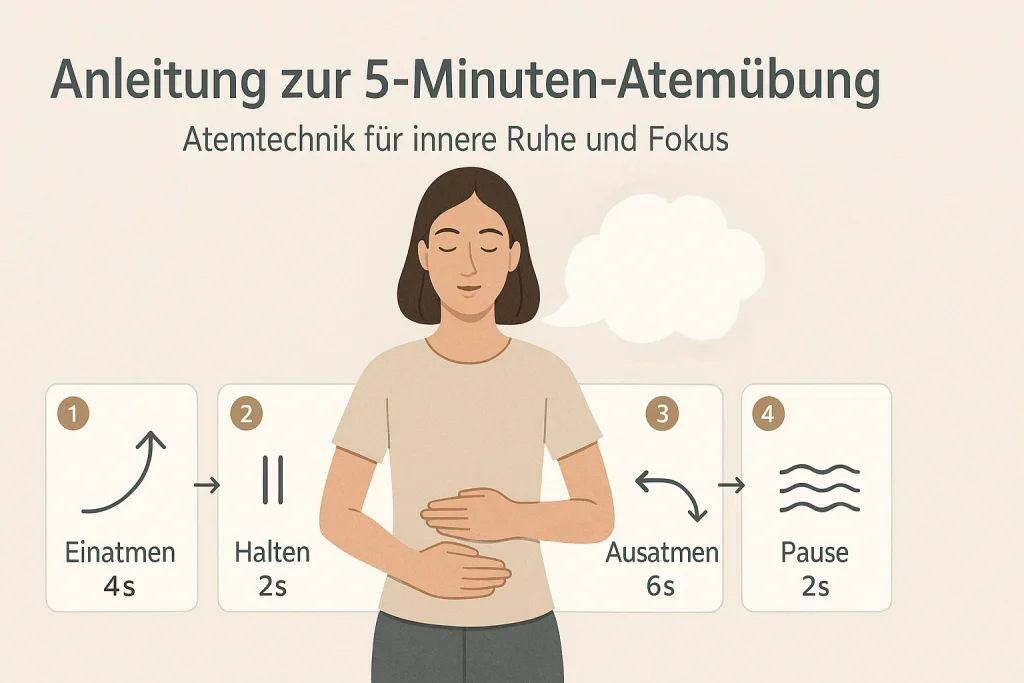
A simple and effective start to the day can be achieved with a short breathing exercise that you can do right after waking up. Many people think that meditation requires special conditions or a lot of time, but that’s not true – an uncomplicated introduction is often the key to getting started in the first place. Five minutes is enough to make a noticeable difference. You don’t need to prepare anything special: just sit where you feel comfortable, keep your spine straight and your posture relaxed. This can be on your bed or in another quiet place that suits you.
To begin with, I recommend that you concentrate entirely on your breathing. Your breath is a natural anchor that is always available and reliably brings you back to the here and now. You may have already noticed that your pulse slows down as soon as you breathe more consciously. There is more to this effect than just imagination: through the parasympathetic nervous system, the part of your nervous system responsible for relaxation, you can positively influence your inner balance with every calm breath. Just one minute of conscious breathing regulates your stress levels noticeably.
What do colors have to do with meditation?
Pause for a moment: Imagine your next meditation session—what image do you see? Many people ignore t…
One particularly popular technique is known as 4-7-8 breathing, which is used in many relaxation studies to specifically activate the parasympathetic nervous system. The exercise is simple: you breathe in, hold your breath, breathe out and pause again – each for equal lengths of time. This conscious control of your breathing rhythm creates a natural brake on inner restlessness. Many people report that after just a few rounds, their heartbeat and thoughts become calmer. It’s not about perfection, but about giving your mind a clear, gentle task. Simply counting your breaths can also help – you direct your attention away from your to-do list and towards your body.
Sit comfortably, straighten your spine and rest your hands loosely. Close your eyes or lower your gaze slightly. Begin with your first breath, following the rhythm: inhale, hold, exhale, hold – all in even counts. Feel how each cycle brings more calm. Let your shoulders drop and observe how your body slowly relaxes. After just a few minutes, your start to the day will feel different: you will be more alert, clearer and less susceptible to external stress.
This short breathing meditation in the morning acts as a little island of protection before everyday life takes hold. It gives your nervous system a moment of rest and prepares you for the demands of the day. Many people report feeling more organised and calm after this exercise – even if the day turns out to be turbulent. No complicated procedures or special prior knowledge are required. The important thing is that you really allow yourself these five minutes and make them an integral part of your morning routine.
Of course, there are days when even five minutes are hard to find or your inner demons are particularly loud. In the next step, we will look at practical solutions for integrating your breathing exercises into your everyday life without them getting lost in the stress.
Staying fit for everyday life: How to make meditation a permanent part of your life – even when things get stressful
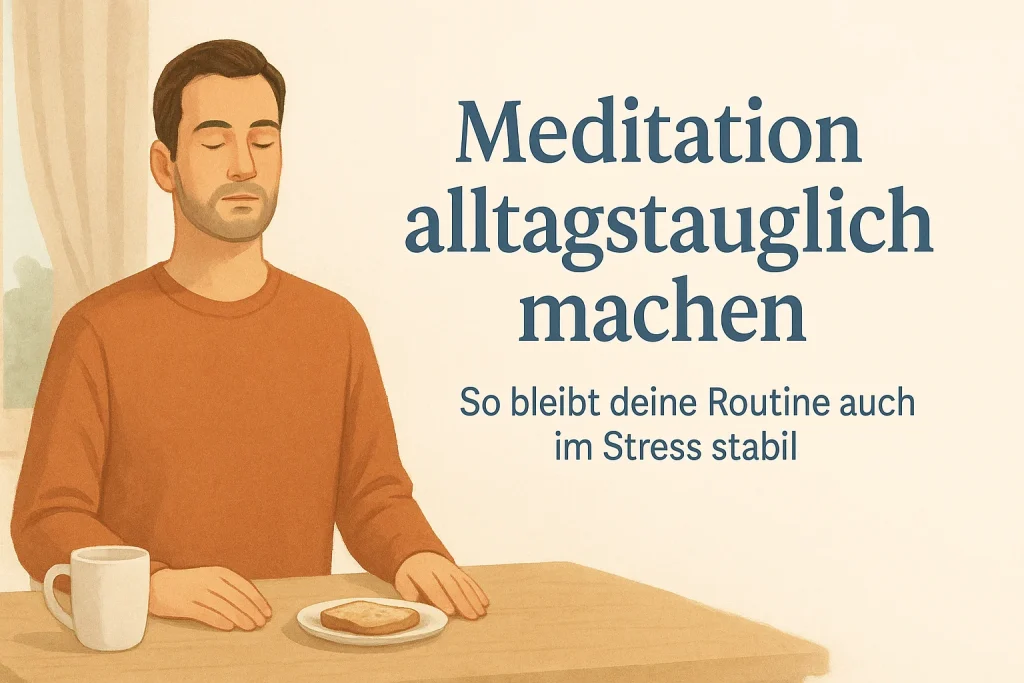
It is precisely when everyday life is busy that it becomes clear how stable a new habit really is. Many people are familiar with this: a fresh morning routine feels motivating at first, but as soon as appointments pile up or you have had a short night, old patterns creep back in. This is not a sign of weakness, but completely normal – our brain loves routines and follows what feels easiest. To integrate meditation permanently, it’s not about doing everything perfectly, but about making small, smart adjustments that fit into your daily routine.
A crucial step is to not view meditation as an additional task, but rather to firmly integrate it into an existing habit. Behavioural research shows that pairing new habits with established routines boosts consistency. Think about what fixed points there are in your morning routine – perhaps brushing your teeth, your first cup of coffee or opening the window. Place your five-minute breathing exercise at precisely this transition point. This will make the threshold to actually getting started much lower. For example, after your alarm clock rings, sit upright in bed for a moment before getting up and start your breathing exercise. Or use the time while the water for your tea is boiling to focus on your breathing.
Popular products
-
Swadhisthana Flow
49,95 € -
Manipura Strength
49,95 € -
Anahata Harmony
49,95 € -
Vishuddha Clarity
49,95 €


Another tip is to consciously eliminate external distractions. Put your mobile phone out of reach for these five minutes so that you are not tempted to check messages or news straight away. This will create a clear, distraction-free space for yourself. Having a fixed place can also help: perhaps you have a small cushion or a specific corner that you use every morning. This gives your brain a clear signal that it is now time for mindfulness.
To lower the barrier even further, use a gentle chime app such as Calm or Insight Timer. Studies on app-based meditation show that such tools increase the likelihood of sticking with it regularly. A gentle sound signals the beginning and end of your practice without stressing you out or pulling you out of the moment. Enter your meditation as a fixed appointment in your calendar, just as you would with other important commitments. If you treat it as a non-negotiable part of your morning, it will be easier to stick with it even on busy days.
It is particularly helpful to keep the exercise as simple as possible. It is not how long or how perfectly you meditate that counts, but that you do it – and preferably on a regular basis. Even five minutes of conscious breathing has a noticeable effect on your nervous system and your mind. If you link meditation to a fixed morning ritual, it will eventually become an automatic part of your day – similar to brushing your teeth.
Over time, you will find that the short breathing exercise is not just another item on your to-do list, but becomes a source of clarity and stability. Even on days when everything is chaotic, this little routine gives you a moment to be completely at peace with yourself. Step by step, a new habit develops that carries you through the day. And sometimes it is only in retrospect that you realise how much these five minutes in the morning change the way you deal with stress and your inner attitude.
Experience shows that it is not about perfection, but about consciously making decisions for yourself – every day anew.
Your morning, your change
Your morning, your change begins precisely when you consciously take time for yourself. With the 5-minute breathing exercise, you can get your day off to a clear start and notice changes after just a short time. Scientific studies show that regular meditation helps reduce stress and increase well-being – one review even found evidence of telomere-related changes in healthy people.
What is the third eye chakra?
Many people immediately associate the third eye with magic or mysticism – but meditation and mindful…
Feel free to share your morning routine in the comments and let us know if you notice a difference in your mood. Just give it a try tomorrow and see how these five minutes affect your day.
Frequently asked questions about morning meditation & 5-minute breathing exercises
Why should I meditate in the morning?
Morning meditation helps you start the day more consciously, focused and stress-free. It is easiest to establish new habits in the morning, as your brain is particularly receptive at this time.
How exactly does the 5-minute breathing exercise work?
Sit comfortably, keep your spine straight, close your eyes and concentrate on your breathing. Count in, hold, breathe out and hold again – always in the same rhythm, e.g. using the 4-7-8 method.
What are the benefits of the 4-7-8 breathing technique?
This breathing technique activates your parasympathetic nervous system, brings rapid calm, reduces stress and has been proven to provide greater inner clarity and serenity.
What should I do if I hardly have any time in the morning?
The exercise takes only five minutes and can be done right after waking up. Tie it into an existing routine, e.g. after brushing your teeth, so that you don’t skip it.
Is the technique also suitable for beginners?
Yes! The breathing exercise presented here is ideal for beginners, as it requires no prior knowledge and is easy to do. All you need is a quiet moment in the morning.
This is how meditation becomes a habit
The real moment when motivation arises Do you know that great feeling you get right after exercising…
5 reasons why your meditation is failing
Why do so many people give up their meditation practice after just a few weeks—even though they know…

