

Imagine that there is a constant invisible commentary running through your head – like a narrator who evaluates everything and likes to rehash worries. Sound familiar? That’s your DMN autopilot, which often sends you into rumination loops. But don’t worry: you don’t have to let it do whatever it wants – there are quick, practical tricks you can use to quiet the merry-go-round of thoughts.
Today, we’re dispelling the myth that meditation means sitting on a cushion for hours on end. I’ll show you a mini exercise that you can try right away – for example, three conscious breaths, no matter where you are. This will help you regain clarity in just 60 seconds.
But before we get started, let’s briefly clarify what actually happens in your mind when autopilot takes over.
Table of contents
Your brain on autopilot – what’s actually going on?

You probably know the feeling: you walk home, unlock the door – and suddenly wonder how you got there. Your body did everything right, but your mind was elsewhere. This is a good example of your brain’s autopilot. Behind this is the so-called default mode network, or DMN for short. It kicks in whenever you’re not focused on a specific task. That means when you’re not consciously controlling your thoughts, but simply letting them drift – for example, when you’re walking, washing up or showering. The DMN is responsible for self-referential thinking; it brings up memories, plans future situations and makes you think about yourself. Researchers have found that certain areas of the brain are particularly active during such moments, such as the medial prefrontal cortex and the posterior cingulate cortex. Imaging techniques show that these DMN nodes fire most actively when you switch off – and become quieter as soon as you concentrate on a task or meditate.
Mindful action
-

Anahata Harmony
49,95 € -
Manipura Strength
49,95 € -
Vishuddha Clarity
49,95 € -
Muladhara Balance
49,95 €




At first glance, this sounds practical, because it allows your brain to tidy up in the background, sort through ideas or prepare you for upcoming situations. Autopilot helps you master routines without having to consciously decide everything all the time. Think of it like an experienced trainer who takes care of the basics so that you can save your energy for the important moments. But: the same mechanism that makes you creative and helps you solve problems can also cause you to get lost in your thoughts. When the merry-go-round of thoughts won’t stop, the useful autopilot quickly becomes an inner saboteur. This happens especially when the DMN becomes too dominant and you can hardly concentrate on the here and now.
That’s why it’s important to know that you have control over how much the autopilot takes over. Even small, conscious breaks can calm the DMN and help you regain focus. And this is exactly where many methods that you may associate with meditation come in – but don’t worry, that doesn’t mean you have to sit still for hours on end. There are simple ways to put this inner coach on pause without completely turning your life upside down.
Now you may be wondering whether it really is that simple. When people think of meditation, many immediately think of complicated rituals or uncomfortable cushions. But is this image actually accurate? And how can you incorporate these mini breaks into your everyday life? That’s exactly what we’re going to look at now.
The myth of meditation: Do I have to sit still for hours on end?

When you think of meditation, you probably immediately picture someone sitting cross-legged with their eyes closed, everything calm, perhaps with a little incense burning in the background. This image persists – and often causes many people to immediately think: “That’s not for me! I can’t even sit still for three minutes, let alone half an hour.” Where does this idea come from, that meditation always looks like it does in a yoga studio or on a meditation retreat?
In fact, this image has been burned into our minds mainly by the media and advertising. Many apps and courses show the “classic” version: everything is quiet, everyone is deeply relaxed, soft music or singing bowls can be heard everywhere. Of course, this can be off-putting for many people at first – especially if you already have little time in your everyday life. But that’s only a small part of the picture. Meditation can be much less complicated and doesn’t have to look like an Instagram idyll.
How to meditate properly
Do you really want to make a change, but everything always sounds so complicated? In fact, neuroscie…
The actual essence of meditation is much simpler: it is about pausing briefly and noticing what is happening inside you and around you. It doesn’t matter whether you’re sitting on the sofa, riding the bus or standing at the supermarket checkout. There’s no need for complicated rituals, special clothing or perfect silence. You can incorporate meditation into your day just as easily as a short walk or brushing your teeth. It’s not about finding the perfect pose, but about a moment of conscious awareness.
Many people believe that meditation is a big deal that requires preparation – as if you had to buy a special cushion and set aside half an hour of your time. But that idea is long outdated. Research shows that even very short, conscious breaks – for example, three deep breaths at a red light or a minute of focused attention – can make a difference. These mini exercises are like little training sessions for your mind. They are not rocket science, and you don’t have to be a professional to do them.
Here are some simple instructions: the next time you find yourself waiting in everyday life, for example at a traffic light or at the checkout, try the following. Focus solely on yourself for 60 seconds. Take three conscious, deep breaths in through your nose and slowly breathe out again. Feel the breath flowing in and out of your body. Let the thoughts that come to mind simply pass by without holding on to them. That’s it. No frills, no noise, no special equipment. Just you and your breath.
It is important to note that this short break will not change everything immediately. It is not a magic button that switches off all your worries or stops the merry-go-round of thoughts at the touch of a button. But – and research clearly shows this – if you incorporate these mini-breaks regularly, you will train your attention. The brain responds to repetition, much like a muscle: the more you practise, the easier it becomes to break out of rumination loops. Studies show that even short, repeated mindfulness exercises can change activity in certain regions of the brain. Areas such as the anterior cingulate cortex and the insula, which are responsible for attention control and conflict monitoring, are particularly affected. At the same time, the dominance of the default mode network decreases, which means that constant rumination and digression are given less space.
This means that even if you consciously pause for just one minute a day, you are setting a process in motion. Over time, you will notice that you slip into automatic thought loops less often. You will be quicker to return to the here and now when your autopilot tries to take over again. This is precisely where the power of this little exercise lies – it is like a mini reset for your mind that is easy to fit into your everyday life.
For advanced practitioners, there are further variations: on your next walk, try to consciously pay attention to your steps or how your feet touch the ground. You can also simply observe for two minutes how your hands hold the shopping bag or how the air flows in and out through your nose. It’s always about directing your attention away from your constant inner commentary and towards what is really happening right now.
Another tip: if you notice that thoughts are distracting you, that’s completely normal. You don’t have to push them away or get annoyed. Just acknowledge them – and gently bring your attention back to your breathing or to what you are feeling right now. That’s exactly what the training effect is: your mind learns not to immediately chase after every thought. Over time, it becomes easier to interrupt the autopilot.
Researchers say that such short, conscious breaks train the brain networks responsible for attention and self-regulation. They reduce habitual reactivity and help you get out of brooding mode more quickly. It’s not about perfection, but about small, regular steps. The more often you incorporate these mini-exercises, the more noticeable the effect will be – less stress, more clarity, a calmer mind.
In the end, it’s not how long or where you meditate that counts, but that you start allowing yourself these little breaks. You don’t need sacred halls, incense sticks or any special talent. You can start anywhere, anytime – and after just a few days, you’ll notice that your mind switches off more easily and you get lost in your thoughts less often.
And now it gets exciting: why does this inner commentator play such an important role? How exactly does the default mode network influence your thoughts, and what happens when it becomes too dominant? We will take a closer look at this in the next step.
The inner narrator: How the DMN guides your thoughts
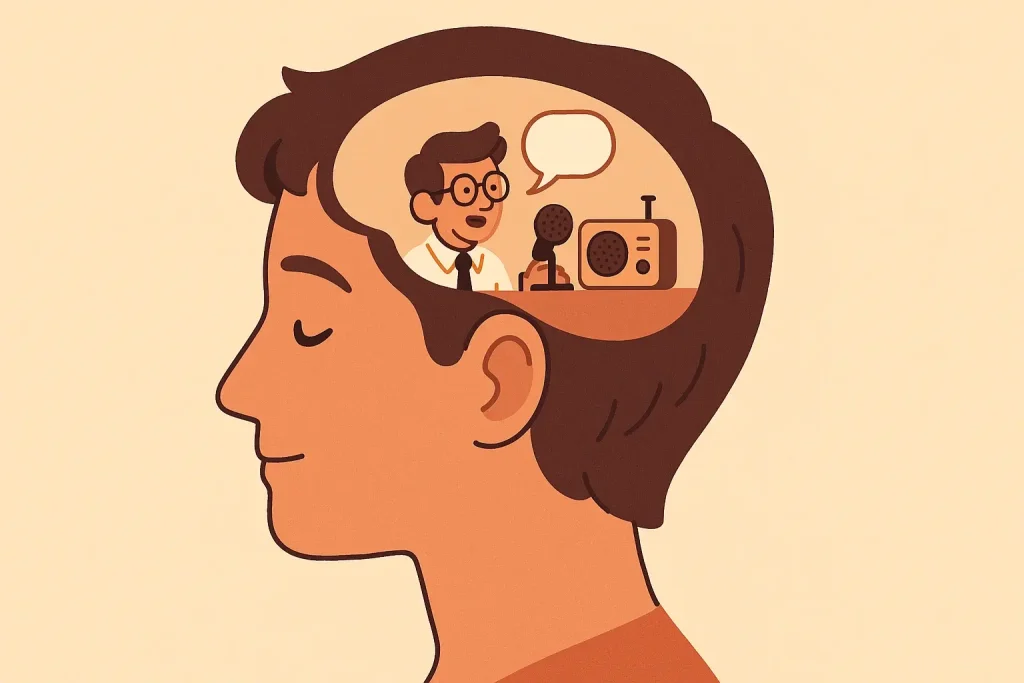
Imagine you have a little commentator in your head who is constantly on air – like a radio that never quite switches off. This inner narrator always pipes up when you are not fully focused: it reminds you of what happened yesterday, makes plans for tomorrow or comments on how you are feeling right now. This is exactly where the default mode network, or DMN for short, comes into play. It’s like a control centre for your self-talk. Whenever you switch off, it kicks in and keeps your mind busy – whether you’re standing in line at the supermarket checkout or in the shower and suddenly think about last week’s meeting.
The DMN is not fundamentally your enemy. On the contrary, it helps you remember things, make plans and find creative solutions. Think of it as a training partner who sometimes gives you brilliant ideas or reminds you of important things. Research shows that the DMN is primarily responsible for self-referential thinking, daydreaming and planning for the future. It can make you creative, help you reflect and ensure that you learn from experience. But as with any good team player, there is also a downside: if the DMN becomes too dominant, it can trap you in rumination loops and worries. Then your mind goes into overdrive, and instead of creative solutions, you end up with endless repetitions and self-doubt.
How can you tell that your inner narrator is currently in control? Typically, you suddenly find yourself lost in memories or worrying about the future without consciously controlling it. Perhaps you just want to relax for a moment, but your mind immediately starts racing – you replay yesterday’s embarrassing conversation in your head or think about everything that needs to be done next week. This often happens in moments when you have nothing specific to do. The DMN is then particularly active, and your thoughts take on a life of their own.
This can be very practical – sometimes the best ideas come to you at precisely these moments. But there is also another side to it: when you suddenly find yourself in a whirlpool of worries, self-doubt or old stories and can no longer easily escape. Especially in the evening, when you want to relax, the DMN can really kick into gear. You’re lying in bed, wanting to sleep, but your inner commentator is going over the whole day’s programme again – from old mistakes to new to-dos.
The good news is that you can learn to recognise this process and consciously control it. The first step is to become aware of your inner narrator. That sounds simple, but it’s not always easy to do in everyday life. Often, the radio of your thoughts plays so quietly and routinely in the background that you hardly notice it – until it suddenly becomes very loud.
Here is a little exercise you can try right now: Take two minutes today, grab a piece of paper and a pen. Sit down and just write down everything that comes to mind – without stopping, without judging, without thinking. Let the pen run, no matter how confused or disjointed the thoughts seem. This is your DMN in action, live and unedited. This exercise is not just a gimmick, but is based on research into metacognition: you learn to observe your thoughts from the outside instead of getting caught up in them. The more often you do this, the clearer you will recognise when your inner commentator takes over – and the easier it will be to stop or redirect it in everyday life.
For advanced users: Turn it into a little thought diary. Regularly spend two minutes writing down everything that spontaneously comes to mind. This will help you recognise patterns, recurring themes or even creative ideas that would otherwise be lost. Over time, you will get a better sense of when the DMN is supporting you – and when it is slowing you down.
The key thing is not to get annoyed when your mind switches to autopilot again. This is not a mistake, but a completely normal part of your thinking. The trick is to notice: “Ah, my DMN is active now. I can decide whether to jump on the merry-go-round of thoughts – or whether to get off.” This realisation alone brings more serenity to everyday life.
Of course, there are phases when your inner critic becomes particularly loud and doesn’t let you off the hook so easily. Especially in the evening, when everything is quiet, the DMN can really pick up speed again – and suddenly your thoughts are going round in circles instead of calming down. Let’s take a look at what helps in this situation and how you can free yourself from such ruminative loops.
When thoughts go round and round: brooding, worrying and the DMN

Do you know that feeling when you just want to switch off in the evening, but your mind is racing like a fairground ride? You lie down in bed, want to sleep, but your thoughts keep going round and round. One minute your mind jumps to an old embarrassing situation, then to your shopping list, then back to some argument. This is exactly where the default mode network, or DMN for short, can sometimes get out of hand. Normally, it helps you sort through your day or develop creative ideas. But when the DMN becomes overactive, you quickly go from thinking to endless brooding – and it feels like your thoughts are spinning faster and faster.
The DMN is designed to remind you of important things, solve problems and make plans. It kicks in during quiet moments because your brain is not distracted. This is actually quite useful, but there is a catch: if there are too many unanswered questions, fears or worries, the DMN constantly searches for solutions – even where there are none. This leads to thought loops that revolve around the same thing over and over again. Rumination, i.e. constantly repeating and chewing over worries, can really weigh on your mood. You feel exhausted, tense or sad, without anything really changing in the situation.
This is how meditation becomes a habit
The real moment when motivation arises Do you know that great feeling you get right after exercising…
Scientifically speaking, this has been well researched: high DMN connectivity is closely linked to rumination and is often observed in depression and anxiety disorders. This does not mean that everyone who ruminates is ill – but it explains why thoughts are sometimes so difficult to switch off. The good news is that mindfulness exercises, i.e. short, conscious breaks and mindfulness training, have been proven to help reduce rumination and lower DMN activity. Many studies show that after mindfulness training, people ruminated less and their brains were able to switch more flexibly between rumination and focused attention. Meta-analyses even show that reducing rumination is an important part of the positive effects on mental health after mindfulness programmes.
Perhaps you have already experienced how a minor concern can suddenly turn into a real problem. You remember a forgotten email, and suddenly you start imagining how everything could go wrong – from an annoyed boss to being fired. The DMN makes mountains out of molehills. Rumination increases stress because the brain keeps replaying the same worries without finding a solution. This is exactly where mindfulness and so-called ‘decentring’ techniques come in: they help you to distance yourself from your thoughts and not let them carry you away so much.
How can you approach this in a practical way? As soon as you notice that your thoughts are going round in circles, there is a very simple technique that can help: the inner stop button. Say a clear “stop” to yourself in your mind. Imagine pressing a big red emergency stop button. The next step is to consciously focus your attention on your breathing. Breathe in slowly through your nose, count to four, pause briefly and breathe out slowly. Feel the air flowing in and out. Everything else can take a break for this moment.
If you notice that breathing makes you feel nervous or causes you to experience unpleasant physical sensations – especially if you have had difficult experiences in the past – start very gently or use a guided meditation. There are many programmes that have been developed specifically for people who have experienced trauma. Be careful not to overdo it; choose a pace that feels right for you.
This little break takes you out of the merry-go-round. The goal is not to stop all thoughts, but to give them less power. With every conscious breath, you bring yourself back a little bit to the here and now. If you like, you can repeat a word such as “calm” or “let go” internally as you exhale. This reinforces the effect and gives your mind a clear signal: now is break time.
For advanced practitioners, there is another variation: observe your thoughts as if you were a coach on the sidelines. You don’t have to intervene or comment on everything – just notice what comes and goes. With a little practice, you will recognise more quickly when the DMN takes over and can consciously counteract it. This takes the edge off your thoughts and helps you become more relaxed.
The important thing is: you are not your thoughts. You are the person who notices when the merry-go-round picks up speed – and who can decide to get off. Just knowing this difference gives you more control over your well-being. Mindfulness is like training for your brain: the more you practise, the easier it becomes to break out of rumination loops and refocus on what is good for you.
However, the DMN is not only the trigger for worries and brooding. It is also behind many creative ideas and spontaneous solutions that sometimes come to you out of nowhere. The trick is to recognise when your mind is stuck in brooding mode – and when it is helping you solve problems or develop new ideas. Sometimes all it takes is a slight change of perspective to break out of the cycle and harness the creative potential of your DMN.
Creativity and DMN: The secret engine behind new ideas

You may have noticed that the best ideas often come to you when you are not actively looking for them – for example, when you are out walking, taking a shower or simply switching off. This is precisely where we see how closely the default mode network, or DMN for short, is linked to your creativity. The DMN is not only responsible for rumination, but is also an important driver of new ideas. It works in the background when you are relaxing or daydreaming, reassembling memories, experiences and knowledge. But – and this is crucial – it only becomes really exciting when the DMN interacts with the so-called executive networks in the brain. It is this interaction that ensures that a flash of inspiration becomes a viable idea. Research shows that creativity arises especially when the brain can switch back and forth between relaxed “inner life” and targeted control. Mind wandering and short breaks help to find new combinations – but you also need a moment of attention to capture the idea and develop it further.
Many people imagine creativity as something that only artists or musicians have. In fact, you need creative solutions everywhere: when solving everyday problems, at work, when cooking, or when you need to coordinate with friends or colleagues. Typically, the best ideas don’t come at your desk, but when you take a break from the problem. Maybe you’ve experienced this before: you’re stuck, you go out for some fresh air, and suddenly you have a brilliant idea. This is no coincidence, but a sign that your DMN is working in the background and making new connections.
The exciting thing about this is that creativity is not a product of chance, but can be trained. Consciously plan short breaks during which you do nothing – no mobile phone, no to-do list, just a moment of idleness. This could be a walk, a glance out of the window or two minutes in which you simply let your thoughts wander. Studies show that such periods of rest significantly increase the likelihood of creative ideas. The so-called incubation phase is particularly effective: if you are working on a problem, then consciously let go and come back to it later with a fresh perspective, the chance of coming up with a new solution increases.
A concrete tip: if you get stuck on a task, switch activities for ten minutes – go for a walk, make yourself a cup of tea or sit by the window. Keep a small notebook or your mobile phone handy so you can write down spontaneous ideas immediately. Many studies show that it is precisely during these “idle moments” that the best ideas arise. This is no guarantee of a flash of inspiration, but it increases the chances of something new popping into your head. It is important not to put yourself under pressure – creativity cannot be forced, but you can create the conditions for it.
For advanced practitioners, there is another trick: imagine you are a coach who briefly takes his team off the pitch so that they can develop new tactics. Consciously allow your mind these breaks from time to time. Try a mini meditation session where you let all your thoughts come and go without holding on to them. Or use targeted daydreaming: let your thoughts run free without immediately looking for a solution. This gives your DMN space to build new combinations – and as soon as you are attentive again, you can pick out the best ideas.
From a scientific point of view, the DMN functions like an internal ideas laboratory. It remixes memories, knowledge and impressions, especially when you are not concentrating on a specific task. But: in order for a good idea to actually come to fruition, your brain needs to work together with the so-called executive networks. These ensure that you recognise your flash of inspiration, write it down and put it into practice. Creativity therefore arises not only from the “free flight” of thoughts, but also from focused attention and the willingness to record ideas.
A common mistake is that we try to force creative solutions – for example, by forcing ourselves to sit in front of the computer until something comes to mind. This is like trying to train a muscle without taking a break. It is much more effective to consciously schedule short breaks. Here’s a tip: take two or three mini-breaks during the day to simply switch off. This could be five minutes on the balcony, a quick walk down the corridor or a glance out of the window. Use this time to let your thoughts drift – and keep a notebook handy in case something occurs to you.
When you gather ideas, write them down immediately, even if they don’t seem fully developed yet. Often, it’s the seemingly crazy ideas that later turn into the best solutions. Make it a little routine: collect your spontaneous flashes of inspiration and review them at the end of the week. This trains your brain to recognise and utilise creative impulses.
Another tip for everyday life: consciously plan small moments when you do nothing. This could be two minutes when you simply breathe, close your eyes or look out of the window. These conscious breaks help your DMN to work in the background and create new connections. The more often you practise this, the easier it will be for you to find creative solutions – not only at work, but also in everyday life.
When you gather ideas, write them down immediately, even if they don’t seem fully developed yet. Often, it’s the seemingly crazy ideas that later turn into the best solutions. Make it a little routine: collect your spontaneous flashes of inspiration and review them at the end of the week. This trains your brain to recognise and utilise creative impulses.
Whether you’re working on a tricky task or just want to clear your head, try taking these little breaks and see what happens. It’s worth giving your mind regular creative breaks. This allows you to make the most of your DMN’s potential – and be ready for new solutions as soon as they’re needed.
Now the question arises: Where exactly is the line between helpful reflection and typical brooding? How can you tell whether your DMN is helping you move forward or holding you back? Let’s take a look at how you can sense the difference in everyday life.
Helpful self-reflection or harmful brooding? Your everyday test

Imagine your head is like a gym: sometimes your workout goes really well, leaving you feeling energised and clear-headed. On other days, you feel exhausted after your “mental workout” and feel like you haven’t made any progress. It’s the same with thinking and brooding – both feel similar at first, but the result is different. The big question is: how can you tell in everyday life whether you are reflecting productively or stuck in a brooding trap?
In everyday life, these two states often blur together. Many people consider themselves to be reflective, when in reality they are just going over the same worries again and again. And sometimes, when you think you are just brooding, you suddenly come up with a good idea. So it is not that easy to tell the difference. But there are a few clear clues you can use to test this in everyday life.
What is the solar plexus chakra?
If you often feel stressed, energyless or irritable, this is sometimes not due to improper nutrition…
Here’s a quick test: Take two minutes to think things over. Write down how you feel and whether you can think of at least one concrete next step. Do you feel clearer, more motivated or even relieved, and do you have at least one idea about how to proceed? Then that was productive self-reflection. If, on the other hand, you remain stuck in the same whirlwind of thoughts, feel heavier or more stressed, and cannot find a new approach, you have probably slipped into brooding. That is the difference: reflection brings movement, brooding stands still.
This can even be scientifically proven in the brain. Constructive self-reflection – i.e. genuine reflection with solutions – activates not only the DMN but also the frontoparietal and executive networks. These areas help you to plan, evaluate and make decisions. When brooding, on the other hand, activity remains almost exclusively in the DMN, as current models from neuroscience show. This explains why you rarely come up with new ideas when brooding – there is no “push” from the other areas of the brain that are responsible for action and changing perspectives.
Feel free to try the test more often. Imagine you are considering whether to change jobs or how to resolve a conflict. After five minutes of thinking, write down three small next steps. If that works, you are on the right track. But if, after thinking, you are still going round in circles and don’t feel any clearer, you have probably just been brooding. The nice thing is that with a little practice, you’ll notice more and more quickly when you’re slipping back into old ruminating patterns.
A practical tip if you find yourself stuck: press the pause button internally. Do a two-minute breathing exercise or a quick body scan. Breathe deeply, feel your body, and just let your thoughts drift by. Then repeat the one-step test: Do you now have a concrete idea or a small next step? This will help you break out of your rumination mode and clear your head.
For advanced learners, it is worth keeping a small notebook. After each reflection session, briefly write down: “Do I feel clearer or heavier now? Is there at least one next step?” Collect these notes for a few weeks. You will see that you recognise patterns: when are you productive, when are you going round in circles? This acts as a training plan for your mind and helps you to pull the emergency brake faster and faster when the merry-go-round of thoughts starts up again.
Another important point: brooding often feels like you are working on a problem – but in most cases, you are just going round in circles. Productive self-reflection, on the other hand, gets you taking action, even if the next step is only a small one. It is enough to simply decide to think about it again tomorrow when you have more time, or to ask someone for advice. The main thing is to get things moving.
If you find that you can’t stop brooding despite all your efforts, sometimes the only thing that helps is distance. Take a short walk, change your perspective or do something completely different. This gives your mind a chance to let go of the issue and come back to it later with a fresh perspective. Many people find that after a break, new ideas suddenly emerge that were previously lost in the jumble of thoughts.
Even small mindfulness exercises can help to stop ruminating. Sit down for two minutes, concentrate on your breathing, and feel the air flowing in and out. Or do a quick body scan: go through your body in your mind, from your toes to your head, and notice what you feel. This brings you back to the here and now and gives your mind a break from the merry-go-round.
Over time, you will become better at recognising the difference between helpful reflection and harmful rumination. You train your mind like a muscle: the more you practise, the easier it becomes to switch modes. And the best part is that you gain clarity, feel less drained and can work more purposefully on solutions.
Sometimes, just a little distance is enough to help you see your own thoughts from a new perspective. It’s not about suppressing or pushing thoughts away – it’s about approaching them with a little more distance. Let’s take a look at how this works.
Decentring – gaining distance from your thoughts

Imagine your thoughts are like clouds in the sky: they appear, change shape, drift away – and you just sit in the stands and watch. That is precisely what the principle of decentring is all about. It is not about ignoring or suppressing thoughts, but about consciously perceiving them without identifying with them. You are the coach on the sidelines, not the player chasing every ball.
In everyday life, we are often so caught up in our thoughts that we don’t even notice how they control us. We often believe that every thought is immediately important or needs to be analysed. But you are not your thoughts – they come and go, and you decide whether to follow them or not. Understanding this immediately brings more ease. It ensures that you waste less energy on ruminating and don’t let every inner comment upset you.
Popular products
-
Vishuddha Clarity
49,95 € -
Shanti Presence
49,95 € -
Sahasrara Connect
49,95 € -
Muladhara Balance
49,95 €


Now here is a practical two-minute exercise that you can do anywhere. Sit down comfortably – on a chair, sofa, park bench, anything will do. If you like, close your eyes. Then let’s begin:
Firstly: Focus your attention on your breathing. You don’t need to change anything, just feel the air flowing in and out.
Secondly: Observe what pops into your head. These can be thoughts, memories, minor worries or even just fragments of everyday life.
Thirdly: As soon as a thought arises, name it briefly in your mind – for example, ‘thought’ or ‘planning’ or ‘memory’. This helps you to gain distance because you realise, ‘Ah, there’s a thought, but I don’t have to jump up and down.’
Fourth: Gently bring your attention back to your breath or another neutral anchor, such as the feeling of your feet on the floor.
That’s all there is to it. No struggle, no pushing away, no drama. You simply observe what is happening and keep coming back to your anchor. The more you practise this, the easier it will become to stop getting caught up in every thought.
For some people – especially those who have had difficult experiences or are under a lot of internal tension – focusing on their own body or breathing can trigger unpleasant feelings or memories. This is completely normal and nothing to worry about. If you notice that observing your body or breathing is making you feel too activated or bringing up old memories, stop the exercise. Instead, use an external anchor: listen to the sounds in the room, quietly count the colours around you, or focus on a point in the room. This is also a form of decentring – just with a gentler introduction. Research clearly shows that people who are prone to intense physical reactions should approach the practice slowly or seek support from experienced trainers, therapists, or trauma-informed services.
If you’re wondering whether this really helps, studies show that this form of decentring – i.e. consciously observing and naming thoughts – calms the default mode network and strengthens emotional distance in the mind. You learn to see thoughts as temporary events, not facts. This gives you more control and makes you more relaxed in everyday life.
A little tip for advanced learners: give your thoughts nicknames. For example, if you keep thinking about “Worry-Worry” or “Doubt-Doubt,” name them that internally. It sounds silly, but it helps enormously to avoid slipping back into old patterns. You’ll recognise more quickly when old thinking habits catch up with you again and can consciously decide how to deal with them.
Over time, you will notice that the more often you do this exercise, the easier it becomes to gain distance. You will no longer be caught up in a whirlwind of thoughts so quickly, but will be able to react from an observer’s perspective. It feels like a small buffer between you and your thoughts – and that is exactly what brings calm and clarity in hectic moments.
It’s like training: the first few times are unfamiliar, maybe even a little bumpy. But the more you stick with it, the more natural observing and letting go become. You develop a new attitude – less drama, more serenity. The energy you used to put into brooding is suddenly available for other things: for creativity, for real focus, or simply for more relaxation.
Sometimes you will still notice that a thought carries you away. No problem! As soon as you notice it, simply return to the role of observer without getting annoyed. It’s like in sports: you lose your footing for a moment, get back up, and carry on. With each attempt, your inner strength grows.
Important: There is no perfect moment for this exercise. You can do it in bed in the morning, during your lunch break or in the evening before going to bed. Even two minutes are enough to feel the difference. And if your breath or body is too intense to use as an anchor, use sounds, colours or count your breaths – the main thing is to find something that keeps you safe and calm.
Decentring is like a toolbox for the mind – you learn to observe your thoughts without immediately acting on them. This makes you more flexible and gives you more freedom in everyday life. Especially in stressful situations, it helps not to react immediately to every inner impulse, but to pause for a moment and observe.
Over time, you will notice how the feeling in your head changes: less stress, more clarity, more confidence in dealing with difficult thoughts. This is not magic, but simply the result of regular training. And the more you practise, the more natural it becomes to take a step back from time to time in everyday life.
In the next step, we will look at how you can use this technique in specific everyday situations – for example, when your mind is particularly noisy or your thoughts are racing again.
DMN hacks for everyday life: Three situations in which you should consciously control yourself

Sometimes your head feels like a radio station that just won’t stop broadcasting – sometimes quietly, sometimes loudly, but always there somehow. In certain everyday situations, the default mode network, i.e. your brain’s autopilot, is particularly active. It often takes control when you appear to be doing nothing. To help you avoid getting stuck in a whirlwind of thoughts, I’ll show you three typical situations in which you can take targeted action – and how you can do so with small, everyday hacks.
First situation: falling asleep. You’re lying in bed, it’s quiet outside, but your mind is racing. This is a classic scenario: as soon as there are no more external stimuli, the DMN goes into overdrive. The brain uses the silence to bring up unfinished tasks, old conversations or worries. This is normal – but if you find yourself going round in circles, it becomes annoying. A short pause can help here: as soon as you notice your thoughts picking up speed, pause. Take three slow, deep breaths, say “stop” to yourself internally and focus your attention on your body for a moment – for example, on the weight of your shoulders or the contact with the pillow. Afterwards, you can do a little progressive relaxation or a mini body scan: Go from your toes to your head in your mind and feel each area for one breath. This only takes one to two minutes. Studies show that such short mindfulness breaks can dampen DMN activity and reduce rumination before falling asleep. There is no guarantee that you will fall asleep immediately, but the likelihood of your mind calming down increases.
What is the throat chakra?
I know this fear of holding back my own thoughts in conversations – out of concern that I will be…
Second everyday situation: the queue at the supermarket. You’re standing there, nothing is happening, and suddenly your mind is everywhere – at the stove at home, thinking about old mistakes or planning for tomorrow. The DMN loves these idle moments because it can spin stories undisturbed. This is exactly where you can take direct countermeasures: use the waiting time for a 60-second body scan. Start with your toes, feel each part of your body for two to three breaths – feet, legs, stomach, shoulders, neck – and then move on. This brings you back from your inner movie to the here and now. Research shows that this technique works because you deliberately shift your attention from your inner narrative to your current sensory impressions. The DMN becomes quieter, you feel more present and are less prone to ruminating. For advanced practitioners: while you wait, say a sentence to yourself such as “I am here, that is enough”. This will make you feel good and break old habits.
Third situation: sport or exercise. Many people go jogging or cycling to clear their heads – and then realise that their thoughts are still stuck on work, their last argument or the future. When exercising, the body runs on autopilot, and the DMN uses the opportunity for daydreaming or minor dramas. Here’s a simple trick that helps: consciously focus your attention on the rhythm of your steps, your breathing or the feeling in your muscles. Take three to five deep breaths in through your nose and out through your mouth. You can do this repeatedly throughout your workout without anyone noticing. Studies show that exercise combined with focused attention reduces stress reactivity more than unconscious training. Even brief moments of conscious awareness during exercise change the activity in your brain’s networks and make your training more effective – for both your body and your mind. An extra tip for advanced practitioners: repeat a motivational phrase such as “Every step is good for me” during your workout. This will help you anchor your attention even more firmly in the moment.
These three little hacks work because they bring you back to the here and now again and again. You don’t just switch off autopilot, you learn to control it in a targeted manner. Over time, it becomes easier to incorporate such micro-exercises into your everyday life – whether you’re falling asleep, waiting in line or exercising. No long meditations or complicated techniques are required. Even short, conscious breaks are enough to calm the DMN and gain more control over your thoughts.
It is important that you stick with it and do the exercises regularly. The more often you use them, the faster you will notice when autopilot takes over – and you can take specific countermeasures. This is not rocket science, but a skill that you train like a muscle. The effect: you feel clearer, calmer and less prone to repetitive thoughts. Research shows that these small changes improve the interaction between networks in the brain. Over time, this helps you to remain calmer and think more creatively, even in stressful situations.
After just a few days, many people notice that they are less prone to ruminating and are living their lives more consciously. It’s not about always doing everything perfectly. It’s much more important to allow yourself to take little breaks now and then and to treat yourself kindly. Every conscious moment counts – and every step towards greater self-control makes a difference.
If you use these techniques regularly, you will notice that not only your thoughts change, but also your everyday life. Suddenly, new ideas emerge, you sleep better and are more relaxed in conversations. These are the side effects of getting to know your autopilot better and better – and that is exactly what we are going to talk about now.
The side effects of mastering autopilot

Imagine suddenly holding not only the remote control for the television in your hand, but also for your own mind. Once you become aware of your inner autopilot and learn to control it more consciously, a change will take place that will affect many areas of your everyday life. Many people start out expecting that a little meditation or mindful use of the DMN will simply make them more relaxed – less stress, quieter nights, the usual stuff. But often, it doesn’t stop at these feel-good effects. There are also changes that you might not have expected: more creativity, new impulses in relationships and a different body awareness.
Take creativity, for example. When you stop letting yourself get caught up in a whirlwind of thoughts and decide for yourself when to pursue something, your perspective changes. You become more open to new ideas and recognise connections that you previously missed. Many people report that they find creative solutions more often in everyday life – fresh ideas suddenly pop into their heads while showering, new thoughts come to them while walking. There is a simple reason for this: your mind is no longer blocked, but back in flow, similar to a muscle that becomes more relaxed after training.
Changes often become apparent in interactions with other people as well. Many notice that they remain calmer in conversations because they recognise more quickly when they are operating on autopilot. Instead of reacting impulsively, you take a deep breath first and can decide more consciously how to respond. This leads to fewer misunderstandings and greater understanding – at work, at home or among friends. It is important to note that these are not promises of perfect relationships, but experiences that many people report after regular practice.
Sleep is a major issue for many people. Those who have learned to put the DMN into rest mode no longer wake up as often at night with racing thoughts. You develop a better awareness of your body and can sense more quickly when your thoughts start spinning again. This helps you stay calmer at night and wake up feeling more rested in the morning. Again, not everyone falls asleep immediately, but many find that they feel more rested after a while.
What does science say about this? Studies show that people who regularly practise mindfulness-based practices (MBPs) not only become more relaxed, but also develop more self-compassion. This means that you treat yourself more kindly, especially in difficult moments. This is not an esoteric promise, but an effect that has been proven in many studies. MBPs strengthen your ability to regulate yourself and cope better with stress. Researchers have also shown that mindfulness changes the way your brain is wired – especially in the networks responsible for self-control and emotional balance. This allows you to respond more flexibly to challenges and ground yourself more quickly.
Here’s an example from everyday life: imagine you’re facing an exam or a difficult conversation. In the past, your autopilot might have immediately brought up old doubts and nervousness. With a little practice, you can now pause, observe what’s happening, and consciously refocus. You no longer react automatically according to old patterns, but decide how to approach the situation. This gives you more peace and clarity, even when things get stressful.
Of course, there are not only positive effects. Some people also experience difficult feelings, inner turmoil or even old memories that come to the surface when practising. Research shows that not everyone has only pleasant experiences. There are reports of feelings of panic, intense reliving or strong emotional reactions – especially in people who have experienced trauma. That’s why it’s important to start mindfully and cautiously. If you know that you have a history of trauma or are very sensitive to internal bodily sensations, start gently and use guided programmes or professional support if possible. Many mindfulness programmes today are designed to be trauma-sensitive and offer a safe environment. Keep checking in with yourself and stop if it becomes too much. This is not a sign of weakness, but an important part of self-care.
Another point that is often underestimated is that changes often first become apparent in small ways. After a few weeks, you may notice that you find yourself brooding less often or that you can calm down more quickly after stressful days. Many people report that they have more confidence in themselves and are generally kinder to themselves. These are not spectacular moments of revelation, but small yet noticeable steps forward.
A practical tip: keep a small journal in which you write down three things in the evening that have changed as a result of consciously controlling your autopilot – no matter how small they are. This is not proof of a huge transformation, but it helps you to notice the development in your everyday life. If you collect these small successes, you will stay more motivated and see that something is changing, even on stressful days.
For advanced learners, it is worth observing the changes over several weeks. Write down when you felt more relaxed, when you were more creative or when you were able to regulate yourself better. It’s like a training log – you can see what works and where you might want to make adjustments.
It is important that you do not put pressure on yourself. It is not about controlling everything perfectly or seeing progress every day. There will be days when everything runs smoothly, and then there will be moments when autopilot takes over and you fall back into old patterns. This is normal and part of the process. Setbacks are not a sign of failure, but part of the training. Be kind to yourself, take breaks and remember: you don’t have to train for a medal. It’s about developing a skill that supports you in your everyday life.
Over time, you will notice that the changes become more and more natural. Perhaps someone will tell you that you seem more present, or you will feel calm even after a stressful week. These are the small signs that you are on the right track.
Many people are now wondering how they can incorporate this new serenity into their everyday lives on a permanent basis without it becoming an additional burden. That’s exactly what we’ll be looking at next – and you’ll see: it doesn’t take any major changes, just a few simple tricks to make mindfulness as natural as brushing your teeth.
How to incorporate DMN mindfulness into your everyday life – without pressure
Perhaps you have already asked yourself how you can really incorporate DMN mindfulness into your everyday life without immediately feeling like you have to turn your whole life upside down. That is exactly what we are going to look at now: how can you become more mindful by taking small, concrete steps – without any pressure, without perfectionism and without it becoming another tiresome chore?
When it comes to mindfulness, many people immediately think of long meditation sessions or complicated routines. But you don’t need any of that. Research shows that there is a correlation between the duration of practice and its effect, but there is no consensus on exactly how much is necessary. There is no fixed minimum amount that guarantees improvement. What is clear, however, is that those who practise more frequently and regularly – even if only in small doses – benefit the most. That’s why it’s better to do lots of short micro-exercises than one big “mindfulness block” per week. It’s like exercise: it’s better to do a few squats every day than run a marathon once a month. The amount of practice counts, but the ideal amount varies from person to person.
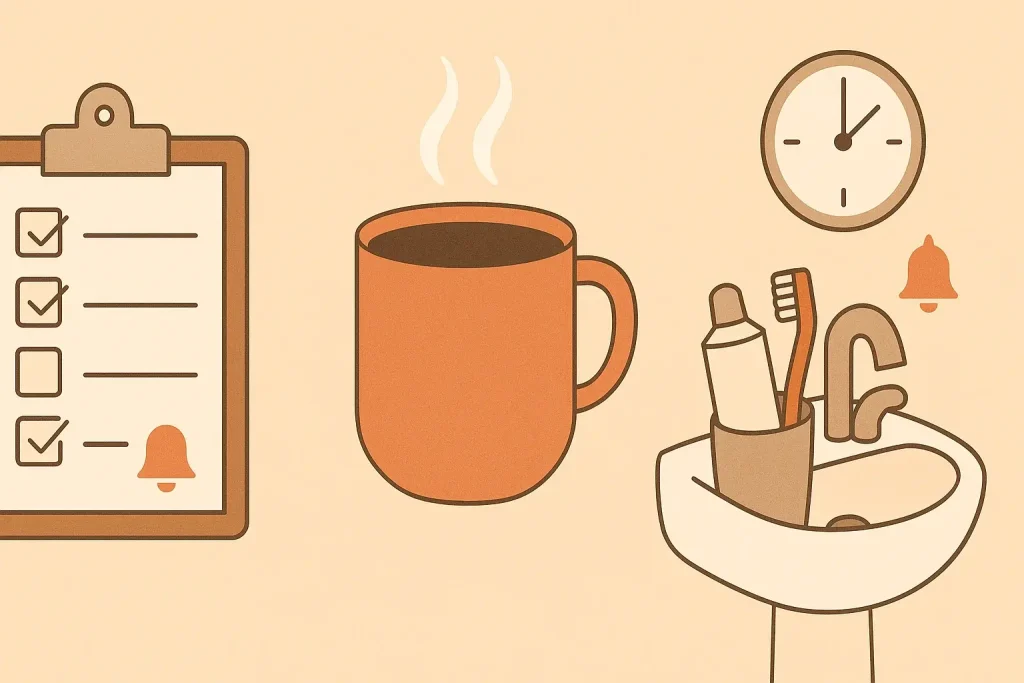
In concrete terms, this means you should find an everyday situation that occurs every day anyway. For example, washing your hands, having your first coffee in the morning or arriving at the office. This will be your personal anchor. From now on, whenever this situation arises, you allow yourself 60 seconds of mini mindfulness. No excuses, no frills, just three conscious breaths, then a 10-second body check – briefly notice how your body feels, which muscles are relaxed, whether you notice any tension anywhere. That’s it. You don’t need a stopwatch or a meditation cushion, just a little bit of attention.
To help you stay on track, write yourself a short note every day: “Today – took one mini break after coffee.” That’s all. One sentence is enough. This way, you can see in black and white that you are really doing something – and that motivates you more than you think. If you feel like it, you can check at the end of the week to see how often it worked. You’ll be surprised how quickly small successes add up.
Here is a very simple micro-plan that you can start right away: Day 1 – After brushing your teeth, pause for 60 seconds, take three deep breaths, and briefly feel your body. Day 2 – Do the same after lunch. Day 3 – While waiting at a traffic light. Day 7 – Look back: Do you feel clearer, calmer, have you noticed a difference? Important: There is no set routine; you can adapt the exercise flexibly. Sometimes it works in the morning, sometimes in the evening – it all counts.
For advanced learners: Once you find that mini-breaks come easily to you, incorporate a little check-in between them. Ask yourself: “How am I feeling right now? What’s on my mind? Is there a thought that keeps coming back?” You don’t have to change anything, just be aware. This will help you recognise patterns and be more conscious of when you’re on autopilot.
Be easy on yourself. There’s no reason to stress if you forget one day or don’t get much done for a week. Research on mindfulness and mindfulness-based practices (MBPs) shows that the effects vary in intensity and can manifest differently in each person. Some people feel more calm after just a few days, while others need a few weeks before they notice any changes. This is completely normal. The important thing is to stick with it and not put pressure on yourself. Progress is rarely linear – sometimes it’s fast, sometimes slow, and sometimes it even feels like it’s standing still. That’s all part of it.
If you find that you don’t feel like it one day or forget, just tick it off and continue the next day. It’s like training: one missed day won’t throw you off track. It’s much more important to keep at it in a friendly way. The less you control yourself and the more you see yourself as a coach rather than a controller, the easier the routine will be. Self-compassion is the key here – and many studies confirm this: those who are kind to themselves stick with it longer and benefit more.
Another tip: tell someone about what you are trying out. Maybe a friend or colleague will join you. Sticking with it together is motivating and gives you the opportunity to share experiences. You can also set little reminders in your everyday life – a note on the mirror, a timer on your mobile phone or a symbol on your desk. Visual anchors like these help to incorporate the new habit into your everyday life.
If you like, you can take stock after a few weeks: What has changed? Do you feel clearer, less stressed, do you sleep better? Write down even the smallest successes. It’s not about big breakthroughs, but about the many small moments when you consciously steer your life instead of just drifting along. That’s the real reward.
And always remember: there is no such thing as “too little” or “too slow”. Every step counts. Research shows that it’s the journey that matters, not the speed. Some changes you will notice quickly, others only after a while. Stay patient and curious – and give yourself the time you need.
If you try this approach, you will notice that the autopilot in your mind can no longer simply do whatever it wants. You will learn to observe it, control it and even use it to your advantage. Find out now how this can be applied in everyday life and why the autopilot is actually your best training partner.
The autopilot is not your enemy – it’s your training partner
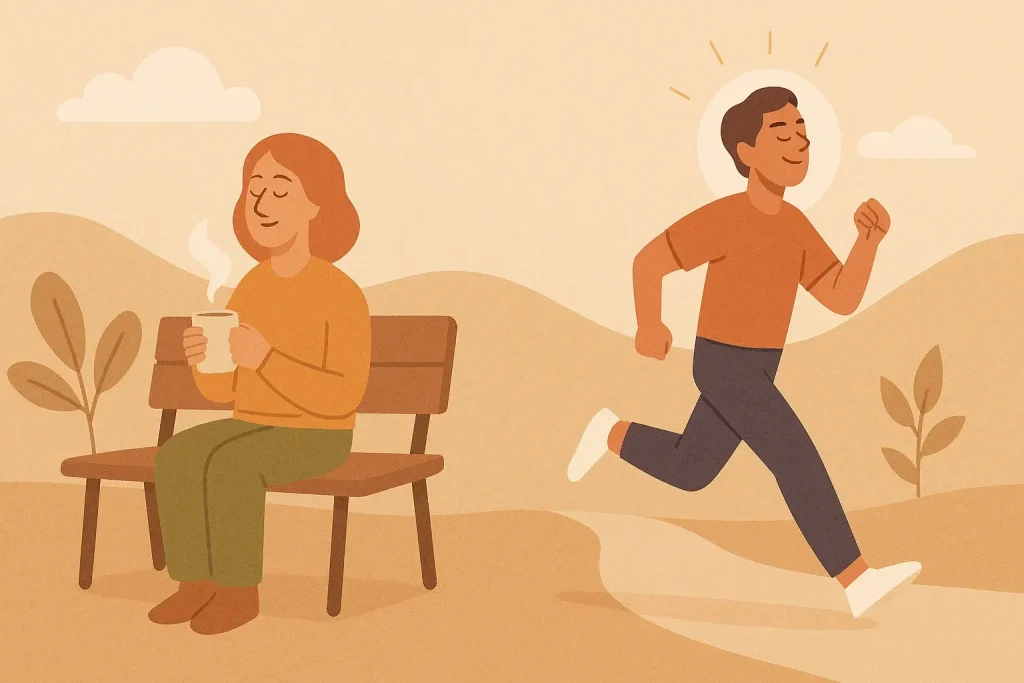
Imagine your mind is like a training partner who accompanies you every day – not as an opponent, but as a coach you can work with. The default mode network is not a dictator, but with a little practice, it can become a team player. Mindfulness and short, conscious breaks help you to ensure that autopilot supports you rather than slowing you down. With each small exercise, your brain adapts: the networks work better together, and you gain more scope for creative, calm and clear moments.
You don’t have to meditate like a pro to do this. Try it out right now: put your mobile phone away for a moment, take three slow breaths and see how it feels. Once you’ve tried this mini exercise, feel free to write “I tried it” in the comments below – you’ll motivate others too.
If you want more practical tools that you can use every day, subscribe to my channel. Stay tuned – small steps make a big difference!
Frequently asked questions about DMN, meditation and racing thoughts
What is the Default Mode Network (DMN)?
The default mode network is a network in the brain that becomes active when you are not focused on external tasks. It plays a major role in brooding, daydreaming and self-reflection.
How can meditation stop my mind from racing?
Meditation helps to calm the DMN and bring you into the here and now. Even short breathing breaks interrupt rumination loops and bring more clarity to the mind.
What quick DMN hacks are there for everyday life?
Take three conscious breaths, pay attention to bodily sensations, or do a 60-second body scan. These little breaks help to control the DMN.
Do I have to meditate for hours to think less?
No, a few minutes are often enough. Short, regular exercises are just as effective as long meditations – the important thing is to make it a routine.
Why is the DMN involved in rumination?
The DMN stimulates inner monologues and memories. If it is too active, you are more likely to fall into rumination loops, which can negatively affect your mood.
How does mindfulness help with stress and inner turmoil?
Mindfulness brings your attention back to the present moment. This reduces stress levels, slows down the whirlwind of thoughts and makes you feel more balanced.
What does decentring mean in relation to thoughts?
Decentring means observing thoughts like passing clouds without judging them or letting them carry you away.
What simple DMN exercise can I try right away?
Sit down for a moment, take three slow, deep breaths and simply observe your thoughts without judging them. That alone is enough to have an initial effect.
Can meditation increase my creativity?
Yes, calming the DMN makes it easier for new ideas to emerge. You gain quicker access to creative impulses and see problems from a different perspective.
Are there any risks associated with meditation for beginners?
Meditation can occasionally cause unpleasant feelings, especially when you are under a lot of stress. Start slowly, choose gentle methods and stop if it becomes too much for you.

