

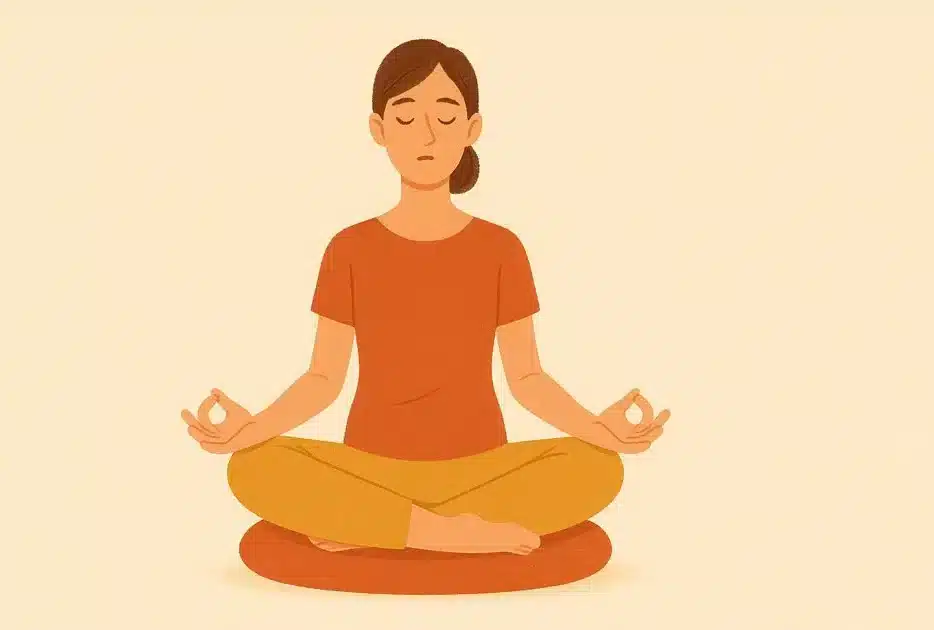
Meditation does not begin in the mind, but in the body. Studies show that an upright spine creates a clear path for energy and focus. Once you understand this, you can breathe more deeply and think more clearly within minutes. Your body—your hips, your back, your hands—plays a crucial role in finding inner peace. Together, we will explore how posture, tension, and small movements help you establish a deeper connection between body and mind. Stay tuned to learn how you can apply these principles in your practice without losing the essence of meditation.
Table of contents
Your body: the forgotten key to meditation
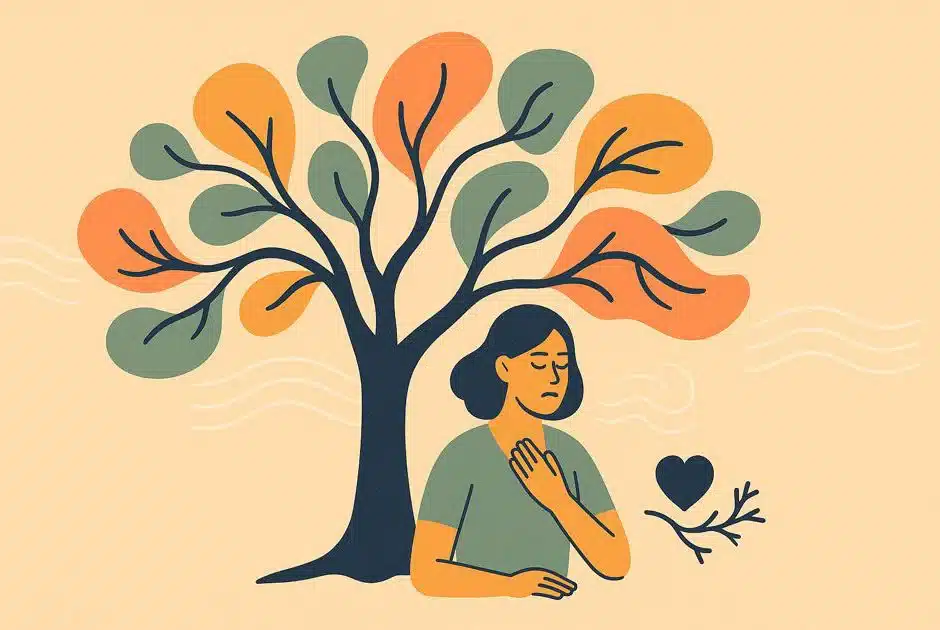
When you think of meditation, you probably picture someone sitting quietly with their eyes closed, breathing. It seems calm and simple – almost self-evident. But this impression often leads to a crucial misjudgement: the assumption that meditation is only a matter of the mind. The body? It is often forgotten. And this is precisely where the key lies. Because the body is never just a passive spectator while your mind wanders through the depths of meditation. In fact, it is the anchor that keeps everything stable.
However, when the body is left out of the equation, it often manifests itself in very noticeable ways. Restlessness, pain or the feeling of being constantly distracted can be the result. Perhaps you have experienced this yourself – you take time for your meditation, want to concentrate, but your mind wanders in all directions. What is often overlooked here is that the state of the body and the way it behaves during meditation has a direct effect on your mind and your ability to relax.
Meditation cushion
-

Blaues Meditationskissen
41,00 € – 49,00 € -

Gelbes Meditationskissen
41,00 € – 49,00 € -
Grünes Meditationskissen
41,00 € – 49,00 € -
Lila Meditationskissen
41,00 € – 49,00 €


Imagine your body as a tree. A tree that is completely rigid will break at the slightest breeze. But a tree that is stable and flexible at the same time can move with the breeze and still remain firmly rooted. This is exactly how your body should be when meditating – stable like the trunk of a tree, but permeable like its branches in the wind.
Science now clearly shows us how closely posture and breathing are linked. A forward-leaning, slumped posture causes shallow breathing, which tends to put the nervous system into a stressed state. In contrast, an upright, grounded posture not only opens up the chest, but also helps to activate the parasympathetic nervous system – the part of your nervous system responsible for relaxation. Simply put, your body influences how deeply your mind can relax.
Perhaps this image will also help you: your body is like an instrument that you can tune to create inner alertness and serenity. If you tune it poorly – i.e. sit down carelessly or remain in an unfavourable posture – then every meditation session will be accompanied by disturbances. But when you begin to consciously align your body, you create a foundation that allows your mind to settle without constantly struggling for stability.
Perhaps you are familiar with this frustration: you want to meditate, do something good for yourself, but it just doesn’t work out the way you imagined. It’s easy to blame your mind: too restless, too distracted. The real cause often remains undiscovered – and may lie in the way you have “prepared” your body. A conscious posture can be the decisive factor that makes all the difference. It’s not about sitting perfectly or enduring hours of meditation sessions. It’s enough to make small changes that put your body in a position that promotes calm, presence and stability.
If you now think that conscious posture means you have to tense up or sit completely rigid, let me clarify this right away: the opposite is true. The art lies in finding the right balance. Conscious upright posture is not the same as a stiff posture that leaves you exhausted after ten minutes. It’s more about balancing stability and ease – just like a tree swaying in the wind. Whether you’re sitting on a meditation cushion, a stool or a chair, your focus should be on finding a posture that allows your breath to flow freely while keeping you grounded.
This insight brings incredible relief. Instead of thinking frustratingly about why your mind won’t quiet down, you begin to focus on your body. You will find that meditation is no longer a struggle with your thoughts, but something that happens naturally and effortlessly. Your body becomes your ally – an active partner in your practice.
And that brings us to the next exciting question: How do you actually feel about this posture? What can you do today to integrate your body more consciously into your practice? It’s not about perfection or complicated requirements. Often, very small, noticeable adjustments are enough. That’s exactly what we’ll take a closer look at in the next section: How to adjust your sitting position so that it supports you, relaxes you and at the same time keeps you alert.
The perfect sitting position: finding grounding and stability
The sitting position is often the first thing we think of when it comes to meditation – and yet its importance often goes unnoticed in the details. Many people imagine the classic lotus position as shown in pictures and films and think that this is the only ‘correct’ posture. But this is a widespread misconception. Studies show that sitting in the lotus position, sitting on a chair or standing – as long as the alignment is correct – can be equally supportive of a focused mind. This takes away the pressure to limit oneself to a certain posture and opens up the practice to everyone.
The problem with unfavourable sitting positions often only becomes apparent after a few minutes: perhaps your leg starts to tingle, your back feels tired, or you notice pressure in your lower back. These minor discomforts can quickly disrupt your entire meditation and cause you to focus more on your body and the pain than on your breath or the silence. The goal of the ideal sitting position is therefore not to ‘tie’ your body rigidly in one place, but to give it a base on which it can hold itself without effort.
Stability is crucial here. Your body should be like a stable anchor – firm but not rigid. Imagine sitting on a foundation that is strong enough to support you but also flexible enough to allow movement. This stability prevents you from having to constantly readjust or reposition yourself. At the same time, a certain amount of permeability is needed so that your breath can flow freely and your body can relax in a natural rhythm. Rigidity, on the other hand, increases internal pressure and distracts you.
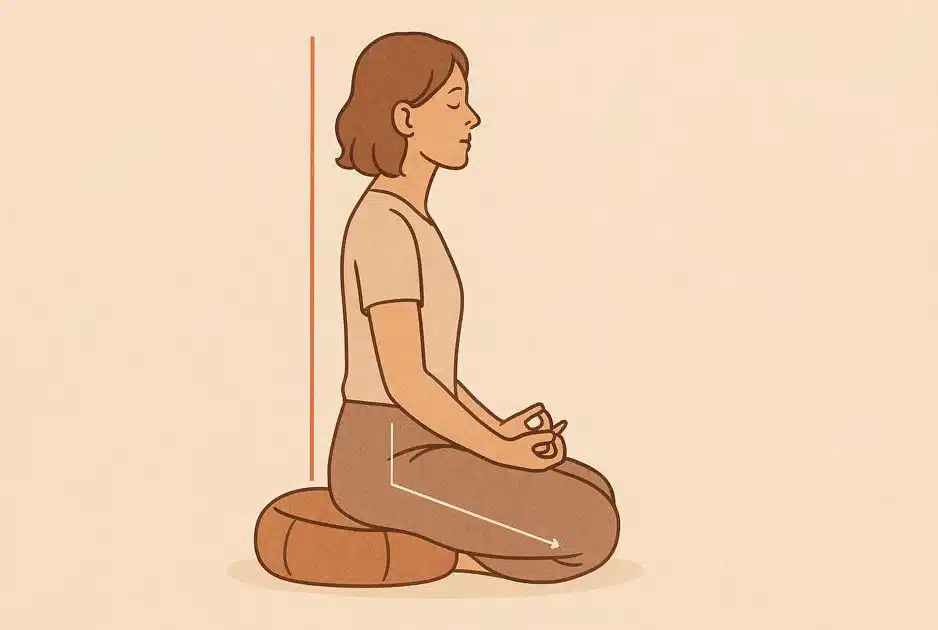
So which sitting position is right for you? The lotus position is just one of many options. You can just as easily meditate on a chair, sit on a meditation stool or use a cushion to create a comfortable position on the floor. Ergonomic principles recommend placing your hips slightly above your knees to allow your breath to flow optimally. If your hips are too low, you tend to sink into your lower back, which often leads to tension. A higher cushion can solve this problem by gently tilting the pelvis forward, supporting the natural alignment of the spine.

Was Meditation wirklich ist – für Leute, die keine Lust auf Blabla haben
Du schließt die Augen, und nach drei Sekunden dreht dein Kopf eine Playlist ab. Gedanken über Termin…
The height and firmness of your seat also play a role. There is no one-size-fits-all solution – experiment with different supports, be it a cushion, a stool or the floor, until you find what feels ‘calm and alert’ for you. A seat that is neither too soft nor too hard will give you stability without creating restlessness or pressure.
Let’s do a quick exercise together to find the right position: Sit upright – either on a cushion, stool or chair. Feel your sitting bones and shift your weight slightly forwards and then backwards until you find the point where you feel grounded. Make sure your pelvis tilts slightly forward and align your spine in its natural shape. Studies show that this small adjustment supports energy flow. Your head should be balanced loosely and your hands should rest relaxed on your thighs or knees. Close your eyes for a moment. Does your breath flow more freely? Do you feel stability without effort?
Exercise: Find your meditation posture
3 steps to a stable meditation posture:
With this simple step-by-step guide, you will quickly find a posture that supports your body and relaxes your mind.
Duration 3 Minuten
Step 1: Laying the foundation (grounding)
Sit on a chair, stool or cushion. Find your sitting bones and shift your weight so that your pelvis tilts slightly forward. Your hips should be slightly above your knees.
Step 2: Straighten the spine (stability)
Gently straighten your spine into its natural S-shape. Imagine a string pulling the top of your head gently upwards. Relax your shoulders and let your head balance loosely on your spine.
Step 3: Release your breath (permeability)
Place your hands in a mudra (e.g. Gyan Mudra) on your knees. Release all unnecessary tension in your jaw and abdomen. Breathe deeply into your abdomen and feel your breath flowing freely and effortlessly. Your body is now your anchor.
Materialien: Meditationskissen, Stuhl oder Hocker
The correct sitting posture directly influences how you breathe, how you feel and how calm your mind can become. Even small adjustments can have an immediate effect. It is an invitation to your body to engage in the practice without resistance – whether you are sitting on a cushion or a kitchen chair.
Mudras: Small gestures, big impact

Our hands – perhaps you don’t think about them much during meditation. They just lie there, quietly on your legs or in your lap, while you focus on your breath or your mind. But what if I told you that your hands can play a crucial role? Small movements, conscious gestures – known as mudras – can set something in motion internally. They act like switches in the nervous system, sending signals to the brain and promoting clarity, calmness or deep connection.
But what exactly are mudras? At first glance, they look like symbolic hand positions, but behind them lies a millennia-old practice from yoga and meditation. Mudras influence the flow of energy in the body and the response of the nervous system through specific hand positions. Researchers refer to nerve points in the fingers that send signals to the brain and thus direct attention. A conscious posture can calm the breath, lower the pulse and focus the mind.
One example is the Gyan Mudra: connect your thumb and index finger while keeping the other fingers loosely extended. Place your hands relaxed on your knees, palms facing upwards. This posture stimulates nerve points that send signals of calm and slow the heartbeat. Studies show that such gestures can activate the parasympathetic nervous system. Try it out: feel how your breathing becomes calmer and deeper.
This week’s popular products
-
28,00 €
Lotus Schale Howlith


Another practical mudra is the Vayu Mudra: press your index finger lightly against your thumb while keeping the other fingers extended. According to traditional practice, this posture is said to alleviate restlessness and harmonise energy flow. Here, too, you can experiment and observe how your breathing and inner peace change.
The Anjali Mudra, in which the palms are placed together in front of the chest, symbolises balance and gratitude. This gesture is often used at the beginning or end of meditation. Feel the gentle warmth between your palms and notice how a feeling of centredness arises. Such gestures act as signals to the body: ‘Everything is in balance.’
You may be wondering, ‘How does this work for me?’ This is where individual experience comes into play. Many meditators report that even small changes—such as connecting your thumb to your index finger—can help you let go internally. These mini elements can create a deeper connection without fundamentally changing your practice.
Try it for yourself: choose a mudra, tune into your body and observe what happens. It is often the small details that make the biggest difference in the long run. Your breath, your body, your mind – everything begins to flow together. This is where meditation comes alive.
In summary
Meditation does not begin in the mind, but in the body – and that is precisely the key to deepening your practice. Perhaps today you have noticed how much easier it is to find peace when your body actively supports you. Research shows that conscious posture reduces the tendency to mind wander by up to X%. Take time to experiment with your sitting posture and try out small changes. If you adjust your sitting posture today and try a mudra, you will feel your mind clearing. Write in the comments which change in your posture helped you the most.
Frequently asked questions: Meditative posture & body focus
Why is my body so restless during meditation?
Restlessness often arises because the body lacks a stable foundation.
Do I have to meditate in the lotus position?
No. The lotus position is not the only ‘correct’ posture. You can meditate on a chair, a stool or a cushion. The important thing is that your spine is upright and your breath can flow freely.
What exactly are mudras and how do they help?
Mudras are conscious hand gestures that stimulate nerve points in the fingers. They act as signals to the brain, for example to promote calmness and focus (such as the Gyan Mudra) and to calm the parasympathetic nervous system.
How do I find the perfect sitting position for me?
The perfect sitting position feels ‘calm and alert’. Make sure your pelvis is tilted slightly forward. Experiment with cushions or stool heights until you feel stable without straining.
How can I deepen my mindfulness when I am in pain?
If you experience pain, adjust your posture. Somatic mindfulness means not ignoring pain. Choose a position that supports you and incorporate small, conscious movements to release tension before entering a state of stillness.

Warum deine Glaubenssätze dich stressen (und wie du sie loswirst)
Es ist kurz vor 22 Uhr, du stehst vor dem Spiegel im Bad, und der Tag war lang und voll….

Meditation ist keine Wellness – aber auch keine Esoterik
Meditation ist kein Spa-Besuch, sondern eher Zähneputzen für den Kopf. Sie ist auch keine Esoterik, …

Atemtechnik vs. Meditation: Was dein Nervensystem wirklich runterbringt
Fünf Minuten am Tag schlugen in einer Stanford-Studie die klassische Meditation. Die Forscher teilte…

Chakra Reinigung Schritt für Schritt: Von der Wurzel bis zum Kronenchakra
Stell dir vor, du läufst seit Wochen auf halber Batterie und weißt nicht, warum. Kein echter Grund z…
